
San Diegans typically peacefully associate with friends, neighbors, family and colleagues whose backgrounds and preferences are different than our own. The diversity of our city is seen everywhere, in its food, music, priorities, and appearance. Generally, these differences add spice to our daily interactions. Often, we become more “well-rounded” from our interactions and learn to incorporate the differences into our own lives. We accept the diversity and grow from it. It is rare that these differences cause such friction as to make it difficult or nearly impossible to move beyond. This article will further highlight five tips for relationships and politics to coexist peacefully.
Then comes election season.
Suddenly, our connections with friends and family are threatened by conflicts with our political policies and partisan views. Conversations at the dinner table with a sibling, parent, or child can become heated before abruptly cooling to chilling stares. Chats on the phone or around the picnic table have you rethinking the sharing your feelings, attending Uncle Dave's poker party, and may even cause you to re-consider friendships you’ve had since high school. Suddenly, those differences that once seemed either inconsequential or perhaps even intriguing are perceived as threatening.
You’ve just logged in to Facebook and see a posting from your best friend or favorite aunt asking you to “Like” a position or politician. Now, it just so happens that you totally dislike this position or politician. What happens next? Your heart may skip-a-beat, and then it begins to race, faster and faster. You may start to breathe just a little bit shallower. You may suddenly want to punch the screen and mail your aunt a bill for the damages. In short, you’re upset and angry.
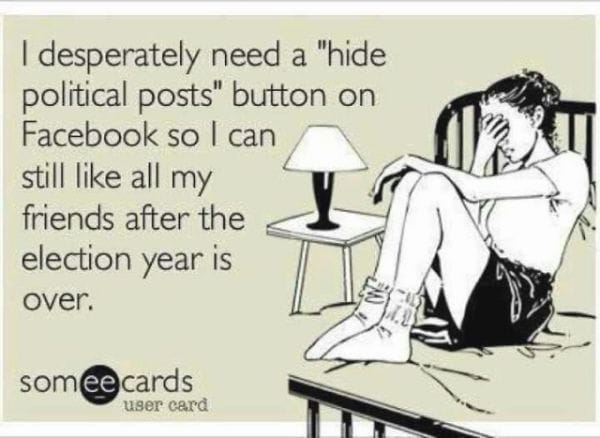
You realize punching the screen won’t help, so you pause and think. Now begins the real internal debate. Should you respond right away, risking an invective-strewn stream of words in ALL CAPS, or wait to craft a measured response to “educate” them in their obvious error? Or, perhaps you could just “take the high road” and block them entirely? Well, you may be relieved that you are not nearly alone. A recent Pew Research Center study reported that nearly one in five users have blocked, hidden or “un-friended” someone over politics.
Before you know it, you and Nanna aren’t speaking anymore.
Why is it that the diversity that once intrigued us, engaged our imaginations and fostered our connections, suddenly repulses us?
As social creatures we look for connections with others. These connections, or social bonds, are sometimes the providence of chance (i.e., “family”). Other times, these bonds are accomplished through our efforts (friends or coworkers) or by our shared beliefs (politics or religion). Regardless of how they form, these bonds are important to us, to our self-realization of identity. It may be ironic, but humans report feeling most independent, and are most comfortable and certain of their individuality, where they experience the security of strong social connections
When we choose sides in politics and adhere to partisan loyalties, we feel like we are part of a community. New bonds are formed and provide additional affirmation of our connection to humanity. Our need to belong to a larger community can thus make our association with even the most extreme associations comforting. That comfort can be intoxicating.
When these associations threaten our already established bonds with family and friends, we have conflict. When we see, hear and experience people we care about in "another camp," we become alarmed. Recall the Facebook example above. Where once there was a close relationship, there is now a growing distance and it feels dangerous. If the bond stretches too thin, we may lose the comfort of acceptance. Stretch that bond too thin, and it snaps.
Faced with the risk of rejection and a broken bond, we begin to fight. The fighting takes the form of debating, arguing, etc., and its done in an effort to gain acquiescence and acceptance. We argue in an attempt to pull them, the “other,” closer to us. Unfortunately, such conflict usually leads to misunderstandings and hurt feelings. The distance grows even wider.
What makes the biennial election season so uniquely agitating?
Generally we keep the "BIG 3", Politics, Religion and Money, out of dinner conversation, family gatherings and general conversation. When we do raise these issues outside of an election season, it’s rare for discussions to become too heated. You know your loved ones, you know their “tells,” and you know when it’s time to pullback and call it a night. You’re in tune with their gestures and demeanor and you know the emotions they are conveying.
During an election season however, we seem to miss the subtle cues that normally give us pause. We are more likely to bulldoze full-speed over the warning signs and plow into the guarded emotions behind them. The effect is rather like sending a demolition to a bridge: if the job is completed then the bond is rendered unusably damaged or broken entirely.
.…Part Two continued here.