
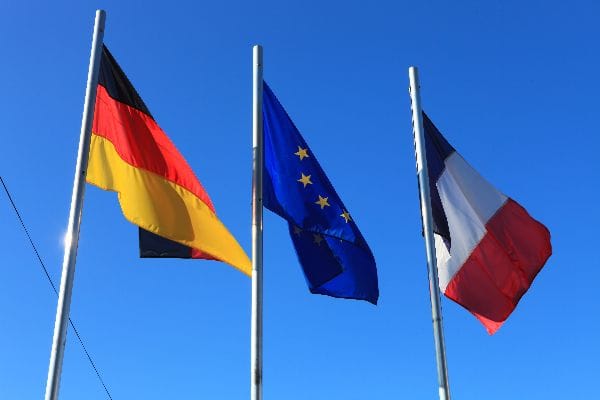
The economies of the Eurozone countries shrunk by 0.1% between July and September, after having already shrunk by 0.2% in the previous quarter. For the second time since 2009, the Eurozone is in recession.
Earlier this week the two main economies of the Eurozone, France and Germany, announced a growth of 0.2 percent for the third quarter. Another recession is no surprise, given the weak results from the regions strongest economies. Not only have the economies of the southern nations remained in the negative (for the 17th consecutive quarter for Greece), but relatively strong economies such as the Netherlands and Austria also saw their economies contract by 1.1 percent and 0.1 percent, respectively. Credit: BBC News

The "austerity cure" has become the main source of blame for the continued stagnation. Waves of protests, including a general strike on November 14, swept European cities, as residents continue to feel the pinch of austerity. Despite popular resistance to national governments, the southern countries continue to make headway on austerity, as directed by Germany and other prominent European finance ministers. Just a week ago, the Greek Parliament passed the most draconian package of spending cuts yet.
However, even these attempts to curb debt are beginning to hear criticism. The International Monetary Fund and the International Institute of Finance (IFF), an association regrouping the 400 biggest bank in the world, are rethinking austerity's value. The head of the IFF, Charles Dallara, said on Wednesday: "It is time to recognize that austerity alone condemns not just Greece but the whole of Europe to the probability of a painful and protracted era of little or no economic growth."
The double dip recession is also attributed to the significant disparity between Northern and Southern European countries. According to the director of the London School Of Economics, "It is a result of excessive austerity in southern countries and unwillingness in the north to do anything else. Countries in the south have to reduce their deficits, but they cannot if those in the north with a surplus are not willing to help with stimulus."
A solution in the short term seems unlikely, as the two major economies of the European Union are simply pointing fingers. Germany, Europe's austerity enforcer, has recently been criticizing France for its limited economic reforms, especially regarding working flexibility for companies. Some German economists go as far as considering France to be the biggest threat to the euro, not debt-ridden Spain or Italy. According to a report by Reuters, the German Finance Minister Wolfgang Schaeuble has asked a board of economists to assess how France might put its economy back in order.
France, on the other hand, believes that Germany has had its share of responsibility in the prolongation of the crisis. Inverse to the countries experiencing deep deficits, Germany's excess indicates a surplus of savings and, in turn, lack of investment. It also denotes an over reliance on foreign markets. European countries buy 70.9% of Germany's exports, promoting Germany's economy to the detriment of other European countries.
More importantly, it is Germany's unwillingness to modify its position on austerity, despite significant doubts of its effectiveness. Although such inflexibility is damaging Europe's economic growth, politics come into play here, with Merkel seeking reelection in 2013.
France will have to make further and deeper economic reforms, Southern countries will have to continue to tighten their belts, and Germany will have to be less stubborn and consider alternatives to pure austerity if the Eurozone wants to overcome the crisis. In the meantime, the economies of the members of the Eurozone are likely to remain in recession or, at best, stagnant in the fourth quarter.