Skip to content
Sign up free
News

Four California Energy Bills to Track This Legislative Session

Four California Energy Bills to Track This Legislative Session

By Michael Abrams

2-minute read

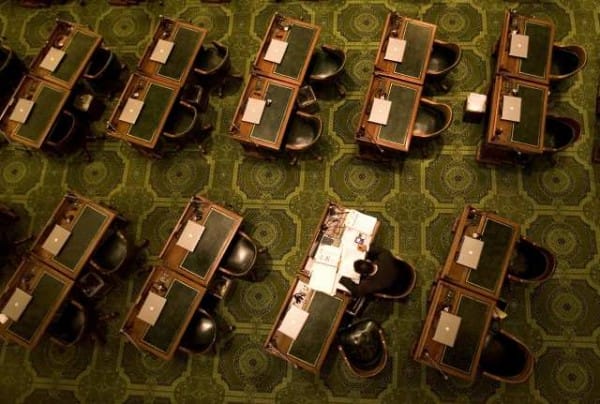
Photo Credit: Robert Durell / Los Angeles Times
Four California Energy Bills to Track

The California state legislature is back in session and the next six weeks will be a grind for legislators. There's a slew of bills waiting to be heard and voted on, but here are four important bills that can change the landscape of energy and environmental policy in the state.

Senate Bill 4 -- Hydraulic Fracturing

SB 4 is sponsored by Senator Fran Pavley and would place regulations on hydraulic fracturing. There are several aspects to the bill, such as the establishment of a study on the effects of fracking, changes to the penalties for fracking violations, and a more robust process to obtain a fracking permit.

The most notable provision set out by the bill is the disclosure of chemicals used and produced in the fracking process.

Fracking produces natural gas and California is home to the largest shale formation in Monterey. There is potentially 15 billion barrels of extractable oil in the area.

Assembly Bill 327 -- Energy Rate Structure

AB 327 has the potential to make the deepest impact in energy policy in California. Assemblymember Henry Perea is sponsoring the bill. Small business, families, and seniors could be worried about a potential big spike in their energy bill. The idea is to make rates fairer by making energy rates more equitable.

California has a tiered energy rate structure that is not based on income. Low-use energy consumers have their energy rates capped by current law. As a consequence, upper tiered customers -- those who use more energy out of necessity -- must bear the burden of increased energy prices.

Asm. Perea stated in the analysis of AB 327:

“[L]aws meant to protect residential rate users are now preventing the CPUC from governing the rate structure and making necessary changes for the thousands of middle to low income families struggling to pay high energy costs.”
Senate Bill 731 - California Environmental Quality Act (CEQA)

SB 731 makes changes to the current California Environmental Quality Act by easing the regulations on certain residential, mixed-use, and commercial "employment center" projects near existing or planned transit stops.

Senate pro Tem Darrell Steinberg stated:

"[The] bill is the result of months of discussion and negotiation with key representatives from the business, environmental, and organized labor communities."
Senate Bill 754 -- Environmental Impact Reports

SB 754 is led by Senator Noreen Evans and is intended to strengthen the current CEQA. Environmental impact reports (EIR) are required in order to take on new projects in California. The bill requires that if a public agency contracts an EIR, that it must be with environmental consultants.

-----

September 13 is the last day for each house to pass bills. Each bill that passes will be sent to Governor Brown's office for a signature or veto. Any legislation that gets signed into law will take effect on New Year's Day 2014.

Tags: News

Adhere to the IVN etiquette

By posting a comment, you agree to adhere to our etiquette rules: No partisan attacks, no personal attacks, substantiate your sources, no self-promotion.

Get IVN’s Free Weekly Newsletter:Get IVN’s Free Newsletter

Get IVN’s Free Weekly Newsletter:Get IVN’s Free Newsletter

Nonpartisan Issues. Diverse Perspectives.

Check your inbox and click the link to confirm.

Republish this article

Republishing guidelines

Republish IVN articles for free. Independent Voter News articles may be republished online or in print under a Creative Commons BY-NC-ND 4.0 license, on these terms:

  1. Credit the author and IVN. Keep the byline ("By Author Name, Independent Voter News") and the attribution note at the end, which links to the original.
  2. Keep the meaning. You may update time and place references and apply your house style. You may trim for length, as long as the cuts don't change the meaning or misrepresent the author. Keep the headline. Mark any additions as your own (for example "Additional reporting by ...").
  3. Translations are welcome. Translate faithfully, add "Translated from English by [your outlet]", and tell us at editor@ivn.us.
  4. Keep the links, including the link to the original article.
  5. Keep the tracking image. The HTML includes a 1-pixel image that counts readers on your page. It collects no personal information.
  6. Photos and illustrations. Images credited to IVN may be used with this article only. Images credited to others (AP, Getty, Unsplash, Wikimedia and so on) stay under their owners' terms. Secure the rights or switch "Include images" off.
  7. Don't sell it. You can't sell our articles or sell ads specifically against them. Your normal site advertising is fine.
  8. No implied endorsement. Don't suggest that IVN or the author endorses you, your candidates or your causes, or that donations to you support IVN.
  9. Keep labels. Opinion or analysis pieces keep that label.
  10. Point search engines to the original. Set the canonical URL of your copy to the original IVN article (the HTML we give you includes the tag).
  11. No bulk or automated republishing, and don't submit our articles to aggregators (Apple News, Google News, MSN) as your own.
  12. Corrections and removals. Update your copy when we correct it, and remove it promptly if we ask. We'll contact you at the email you give us.
  13. Questions or print republication: editor@ivn.us.

IVN staff: fill in who you're inviting above, then create the invite.

Preparing the article

Four California Energy Bills to Track This Legislative Session

Choose a format
  • HTML
  • Email HTML
  • Markdown
  • Formatted (.docx)
  • Plain text
  • WordPress blocks
  • PDF
Choose a platform

Photos credited to others need their owners' permission.

To for

Republishing somewhere else? Questions? editor@ivn.us