Skip to content
Sign up free
News

Home Price Recovery Linked to Taxpayer Burden

By State Data Lab

2-minute read

IVN-HomePrices

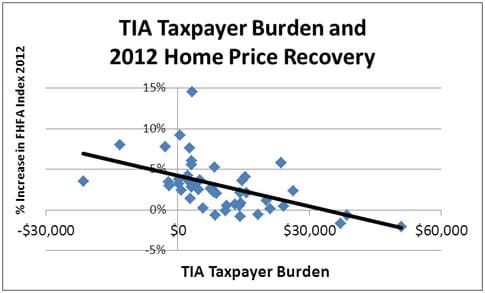
In 2012, states with higher taxpayer burdens had a lower recovery in home prices.

The American dream is to own a home, and it’s every American’s dream that the price of his/her home rises continually. Of course, there are many reasons for a change in the price of any single house—the local housing market, a neighborhood renovation, the construction of a nuclear power plant—but there are also broad statewide trends, which leads to an important question:

Can political decisions influence the price of the single largest asset for many Americans?

Home prices have endured a roller coaster ride in the past decade, tumbling throughout the nation during the recent Great Recession, but last year the 50 state average for the Federal Housing Finance Agency (FHFA) house price index posted its first increase in the past five years.

There was a great deal of variation across the fifty states, however, in the amount of recovery enjoyed. One factor at work appears to be state government financial conditions.  Consistent with evidence of higher outmigration in fiscally challenged states, the FHFA home price index posted significantly lower changes, or even declines in 2012, in states with higher Truth in Accounting (TIA) estimates for state taxpayer burdens.

According to this survey, home prices continued to decline in seven states in 2012– Connecticut, Delaware, Illinois, Maine, New Hampshire, New Jersey, and Rhode Island.  The average TIA Taxpayer Burden estimate for these seven states comes to roughly $25,000, nearly four times as high as the average of about $7,200 for the other 41 of the 48 continental United States.

Of course, all voters are not homeowners, and the promotion of home ownership though public policy can lead to distorted market prices, which played a major part in recent economic troubles. It is important to monitor states' financial positions because policies leading to weak fiscal health have had broader economic consequences that all voters care about, not just homeowners.

For all Americans who own homes or dream about that perfect brick townhouse or a peaceful country cabin, perhaps it’s time to examine your state’s finances—because they might have a big effect on your personal finances

Tags: News

Adhere to the IVN etiquette

By posting a comment, you agree to adhere to our etiquette rules: No partisan attacks, no personal attacks, substantiate your sources, no self-promotion.

Get IVN’s Free Weekly Newsletter:Get IVN’s Free Newsletter

Get IVN’s Free Weekly Newsletter:Get IVN’s Free Newsletter

Nonpartisan Issues. Diverse Perspectives.

Check your inbox and click the link to confirm.

Republish this article

Republishing guidelines

Republish IVN articles for free. Independent Voter News articles may be republished online or in print under a Creative Commons BY-NC-ND 4.0 license, on these terms:

  1. Credit the author and IVN. Keep the byline ("By Author Name, Independent Voter News") and the attribution note at the end, which links to the original.
  2. Keep the meaning. You may update time and place references and apply your house style. You may trim for length, as long as the cuts don't change the meaning or misrepresent the author. Keep the headline. Mark any additions as your own (for example "Additional reporting by ...").
  3. Translations are welcome. Translate faithfully, add "Translated from English by [your outlet]", and tell us at editor@ivn.us.
  4. Keep the links, including the link to the original article.
  5. Keep the tracking image. The HTML includes a 1-pixel image that counts readers on your page. It collects no personal information.
  6. Photos and illustrations. Images credited to IVN may be used with this article only. Images credited to others (AP, Getty, Unsplash, Wikimedia and so on) stay under their owners' terms. Secure the rights or switch "Include images" off.
  7. Don't sell it. You can't sell our articles or sell ads specifically against them. Your normal site advertising is fine.
  8. No implied endorsement. Don't suggest that IVN or the author endorses you, your candidates or your causes, or that donations to you support IVN.
  9. Keep labels. Opinion or analysis pieces keep that label.
  10. Point search engines to the original. Set the canonical URL of your copy to the original IVN article (the HTML we give you includes the tag).
  11. No bulk or automated republishing, and don't submit our articles to aggregators (Apple News, Google News, MSN) as your own.
  12. Corrections and removals. Update your copy when we correct it, and remove it promptly if we ask. We'll contact you at the email you give us.
  13. Questions or print republication: editor@ivn.us.

IVN staff: fill in who you're inviting above, then create the invite.

Preparing the article

Home Price Recovery Linked to Taxpayer Burden

Choose a format
  • HTML
  • Email HTML
  • Markdown
  • Formatted (.docx)
  • Plain text
  • WordPress blocks
  • PDF
Choose a platform

Photos credited to others need their owners' permission.

To for

Republishing somewhere else? Questions? editor@ivn.us