Skip to content
Sign up free
News

In Arab Nations, Facebook is the Third Most Popular News Source

In Arab Nations, Facebook is the Third Most Popular News Source

By Jane Susskind

2-minute read

Distrust in traditional media sources is not limited to the United States and is prevalent in nations in the Middle East, according to recent research conducted by Northwestern University in Qatar.

The survey focused on eight countries in the region: Qatar, Bahrain, Egypt, Jordan, Saudi Arabia, Lebanon, Tunisia, and the United Arab Emirates (UAE). When asked about the credibility of news media, only 48 percent of respondents responded positively. Broken down by nation, trust in the media is lowest in Tunisia, Lebanon, and Egypt, hovering roughly at 25 percent.

In place of traditional media, Middle East nations are increasingly turning to social media to gather and share news. In fact, Facebook is now the third most popular news source in Arab nations, topped only by Al-Jazeera and Al-Arabiya.
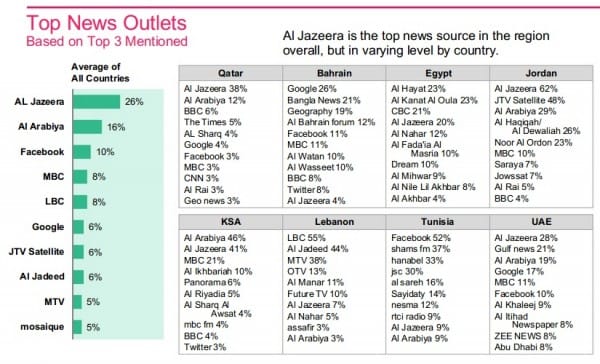
Arab Nations, Facebook

In Tunisia, for example, Facebook is the number one source for news, with 52 percent of respondent reporting they use Facebook more than any other source to gather news.

One of the study's lead researchers, Northwestern journalism professor Justin Martin, points to the nature of information sharing prevalent in the region. In Arab nations, interpersonal sources are a primary source of credibility when sharing news and current events, as is the Internet. Social media combines these two functions, providing users an online newsfeed populated with information shared by their friends and family.

"Arabs, maybe more than any other culture around the world, have these anchored communities where they receive and share news and information and they tend to go there often for news and they tend to trust the information from their anchored communities," Martin explains.

The social sharing of news and information, consequently, is an extension of their trust in anchored communities and their social nature, something lacking in Western countries.

In Bahrain, for example, 99 percent of everyone online uses social networking sites. In the United States, that number drops to 67 percent, drawing attention to the importance of interpersonal connections in the Middle East. While Americans are increasingly turning to social media for news, their activities on the Internet range significantly. In Arab nations, however, respondents' primarily use the Internet for instant messaging, resulting in higher rates of social media use among Internet users.

At the top of the list of social networks used in the Middle East is Facebook, with 94 percent of social media users logging on to the site.

Facebook's popularity among Internet users in the Middle East arose in 2010, when it played an instrumental role in facilitating the Arab Spring protests. Dubbed the "Facebook Revolution," the Arab Spring showcased the capacities of an online service and the power a social network can have on society as a whole.

Facebook allows for the free flow of information, unfiltered news, collaborative efforts, and organization at a speed that was previously unavailable.

With trust in the media declining in both the Middle East and America, the future of the news is social.

Tags: News

Adhere to the IVN etiquette

By posting a comment, you agree to adhere to our etiquette rules: No partisan attacks, no personal attacks, substantiate your sources, no self-promotion.

Get IVN’s Free Weekly Newsletter:Get IVN’s Free Newsletter

Get IVN’s Free Weekly Newsletter:Get IVN’s Free Newsletter

Nonpartisan Issues. Diverse Perspectives.

Check your inbox and click the link to confirm.

Republish this article

Republishing guidelines

Republish IVN articles for free. Independent Voter News articles may be republished online or in print under a Creative Commons BY-NC-ND 4.0 license, on these terms:

  1. Credit the author and IVN. Keep the byline ("By Author Name, Independent Voter News") and the attribution note at the end, which links to the original.
  2. Keep the meaning. You may update time and place references and apply your house style. You may trim for length, as long as the cuts don't change the meaning or misrepresent the author. Keep the headline. Mark any additions as your own (for example "Additional reporting by ...").
  3. Translations are welcome. Translate faithfully, add "Translated from English by [your outlet]", and tell us at editor@ivn.us.
  4. Keep the links, including the link to the original article.
  5. Keep the tracking image. The HTML includes a 1-pixel image that counts readers on your page. It collects no personal information.
  6. Photos and illustrations. Images credited to IVN may be used with this article only. Images credited to others (AP, Getty, Unsplash, Wikimedia and so on) stay under their owners' terms. Secure the rights or switch "Include images" off.
  7. Don't sell it. You can't sell our articles or sell ads specifically against them. Your normal site advertising is fine.
  8. No implied endorsement. Don't suggest that IVN or the author endorses you, your candidates or your causes, or that donations to you support IVN.
  9. Keep labels. Opinion or analysis pieces keep that label.
  10. Point search engines to the original. Set the canonical URL of your copy to the original IVN article (the HTML we give you includes the tag).
  11. No bulk or automated republishing, and don't submit our articles to aggregators (Apple News, Google News, MSN) as your own.
  12. Corrections and removals. Update your copy when we correct it, and remove it promptly if we ask. We'll contact you at the email you give us.
  13. Questions or print republication: editor@ivn.us.

IVN staff: fill in who you're inviting above, then create the invite.

Preparing the article

In Arab Nations, Facebook is the Third Most Popular News Source

Choose a format
  • HTML
  • Email HTML
  • Markdown
  • Formatted (.docx)
  • Plain text
  • WordPress blocks
  • PDF
Choose a platform

Photos credited to others need their owners' permission.

To for

Republishing somewhere else? Questions? editor@ivn.us