
Assange and President Correa Talk on Russia Today (Youtube / RT)
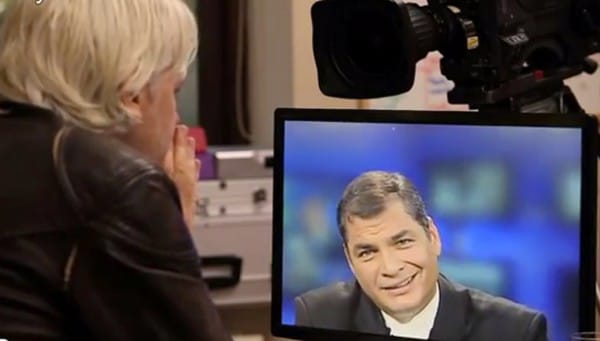
On Sunday Julian Assange stood in the Ecuadorian embassy in London to deliver a ten-minute speech condemning the actions of Britain, Sweden, and the United States for their treatment of the WikiLeaks founder.
The embassy standoff shows that governments are under pressure to enter a new world of rapid technological advancements that policy often has trouble keeping up with. So far, international law has kept both WikiLeaks and its founder safe. When the standoff finally concludes, the United States will have to re-evaluate its policy gaps to deal with a rapidly changing global landscape of emerging technologies and media.
In terms of international norms, secrecy and clandestine government agencies are accepted and recognized from state to state. Today the Internet is a threat to this paradigm as online discussion has stirred up a demand for transparency while enabling whistleblowers to reach their audience with great ease. Leaked documents no longer need to go through major, corporately-owned news outlets anchored in the United States or other countries to reach the public eye. Anyone with Internet access and expertise with hacking or access to sensitive material can now spread it over the entire world in a matter of seconds with relative anonymity.
Currently US law allows its government to act in secret and prosecute whistleblowers for sharing state secrets. In some cases this allows for sensitive opinions to be openly discussed without emotional politics derailing a diplomatic process as the leaked cables did with US-Ecuador relations in 2010. Other times secrecy can be used to hide important information about government malfeasance from voters.
Reforms to US policy in light of WikiLeaks would need to address both legitimate government secrets and the misuse of secrecy. The latter could be addressed through increased transparency to ensure that voters feel they have all the information vital to them as voters and citizens, and thereby reduce popular demand for services that disseminate information "leaks." The former could be addressed through increased government security and a greater emphasis on winning the government's ongoing battle with hackers.
In March of this year one of the FBI’s top officials said that between domestic and foreign hackers, the US is losing the cyber war miserably. Currently hacking is a highly-developed skill that does not promise much monetary gain in the public sector. Were the US to invest in hiring and training counter and offensive hackers, this problem could be greatly reduced. With smarter policy on the part of the United States allowing for more openness with its citizens and the more aggressive use of public sector technology experts to provide better cyber security for legitimate secrets, the country could eliminate much of the need for websites like WikiLeaks and better protect the secrets it does keep.
As the standoff continues it has become increasingly clear that the battle is not about Assange nor even WikiLeaks, but how governments are reacting to a new political tool in a rapidly changing world.