
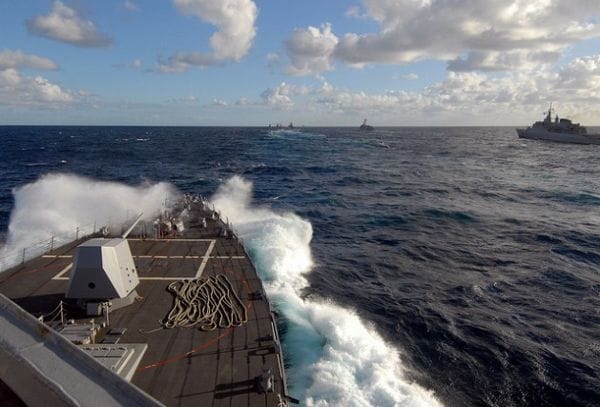
Credit: US Navy
QUESTION: What do you call a 30-year-old agreement that has the support of President Obama, former President Bush, former President Clinton, the other former President Bush, every living Secretary of State of both parties, the Joint Chiefs of Staff of the military, the U.S. Coast Guard, the National Association of Manufacturers, the U.S. Chamber of Commerce, the Telecommunications Industry Association, the American Petroleum Institute, oil companies (like Exxon and Chevron), cable communications companies (like Verizon and AT&T), defense contractors (like Lockheed Martin), mining companies, numerous environmental groups (like Oceana and World Wildlife Fund), a bipartisan majority of U.S. Senators (like John Kerry and John McCain), and many more, including 162 other nations, but is blocked by a Republican Senate minority?
ANSWER: You call it the United Nations Convention on the Law of the Sea, or UNCLOS, even though Republicans prefer to refer to it pejoratively as LOST, for Law of the Sea Treaty.
How many of you know what UNCLOS is? I see a few hands, including mine.
And how many of you have read it? No one? Me, neither.
UNCLOS, the United Nations Convention on the Law of the Sea, is a long and comprehensive attempt to create a consistent legal framework for the 70% of the world’s surface that is water. Currently it has seventeen sections containing 320 Articles, as well as nine annexes and other elements.
The law of the sea has long been a serious concern for most nations, including the United States from its early skirmished with Barbary pirates and the Royal British Navy. The current effort to achieve a uniform, global law of the sea began in 1958, with the first of two United Nations conferences on the law of the sea in Geneva, in landlocked Switzerland.
More than twenty years of negotiations led to the presentation of UNCLOS in 1982, and its subsequent adoption by 162 countries around the world. The United States, under President Reagan, refused to sign and is the only industrialized country in the world still outside the law as a whole But Reagan did issue executive orders adopting acceptable sections, while seeking renegotiation of the objectionable parts.
Among the other nations that have not signed on to the law of the sea are North Korea, Iran, Libya, Venezuela, Turkey, Syria, and Israel, along with Afghanistan, Bhutan, Rwanda and other landlocked nations, including all the former Soviet republics of central Asia. With an eye on the world community, the Reagan Administration continued negotiating on the treaty, with some success, but Reagan never signed it.
The succeeding Bush and Clinton administrations continued to negotiate, until the latter achieved a renegotiated treaty in 1994, a stronger treaty from the U.S. perspective, and President Clinton signed it. To have the full force of law under the U.S. Constitution (Article II, sec. 2), a treaty must be ratified by a two-thirds vote of the Senate. Since 1994, the Senate has voted on this treaty exactly never.
The Obama administration has been working toward a Senate vote some time this year. Last spring the Senate Foreign Relations Committee, chaired by Sen. John Kerry (D-MA) held hearings at which the broad array of supporters from the Pentagon and elsewhere were heard, along with some opponents. But before those hearing even started, House Republicans pushed through an amendment to the fiscal 2013 defense budget plan by a 229-193 vote, prohibiting any spending to implement the law of the sea.
Although the UNCLOS treaty has not yet been voted out of committee, the chance of its passing by a two-thirds vote in the Senate appeared to die on July 16, when Republican Senators Rob Portman (Ohio) and Kelly Ayotte (NH) joined 32 other Republican Senators in stated opposition. This leaves the supporters of the treaty with 66 votes where 67 are needed for ratification.
In their 3-page letter, Portman and Ayotte had essentially two objections to the treaty: it’s limits on American pollution and risks to U.S. sovereignty in general. The letter focuses first on pollution, objecting to sections that would “prevent, reduce and control pollution of the marine environment from any source….” While this is a specific curb on U.S. sovereignty, the senators also expressed concerns about possible curbs on American judicial, economic, and military authority.
Perhaps the key to their thinking is in this sentence starting the fourth paragraph: “The treaty’s breadth and ambiguity might be less troubling if there were adequate assurance that it will be enforced impartially and in a manner consistent with U.S. interests.” This is an oxymoronic construction, since “a manner consistent with U.S. interests” is, by definition, not impartial. No wonder the Republican position has broad-based opposition such as the American Sovereignty Campaign, an umbrella group representing national security, commercial, and environmental interests.
In the real world, the United States has lived within the bounds of the treaty since 1982, even while working to modify it. The country’s current status as an effective outlaw is not only troubling to a broad array of often competing interests, but not a little ironic, since the treaty came into being in large part thanks to American efforts.
And from a practical standpoint, being part of UNCLOS, the United Nations Convention on the Law of the Sea, might well ease tensions in areas like the Strait of Hormuz between Saudi Arabia and Iran, or even in the South China Sea, where China is making territorial demands that are sharply disputed by other nations in the region.
The Senate needs to ratify Law of the Sea.