Skip to content
Sign up free
News

LCFF Moves California to End Recent No Child Left Behind Waiver Effort

LCFF Moves California to End Recent No Child Left Behind Waiver Effort

By Michael Abrams

2-minute read

California Ends Effort to Seek Exemption from No Child Left Behind

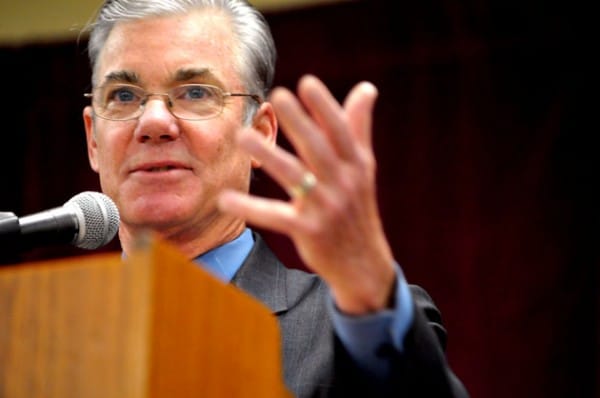
California Superintendent of Public Instruction Tom Torlakson, photo credit: Lara Cooper / Noozhawk.com

Complicated relations between California and the federal government on a state waiver for No Child Left Behind (NCLB) reached its conclusion. Seeing the effort as futile, the California Department of Education (CDE) announced it will no longer seek a waiver from the federal law. Schools continuing to under-perform based on NCLB may face federal sanctions in the near future.

The CDE is prioritizing Governor Jerry Brown's local control funding formula (LCFF) proposal over the possibility of obtaining a waiver. LCFF includes a new delegation of school funds based on the proportion of disadvantaged students in a district. However, the spending autonomy given to local districts in Brown's plan is said to be the complicating factor when state and federal officials discussed NCLB waiver requirements.

California Superintendent of Public Instruction Tom Torlakson and President of the State Board of Education Michael Kirst released a joint statement on Monday:

"While California’s efforts to improve its education system continue to move forward, including implementation of the Common Core State Standards and the modernization of our assessment and accountability systems, the standards for obtaining a federal waiver remain difficult to meet for a state committed to local flexibility and decision-making"

In the May revision of the 2013-2014 state budget proposal by Brown, the local control component of the plan:

"[LCFF] fundamentally shifts accountability from a system focused on state control of local spending to a system of local planning and goal setting to improve outcomes for students."

There are 37 states that have successfully obtained a NCLB waiver. Each waiver process has been an exchange of potential sanctions set by NCLB for federal reform measures. In California's case, the state is not submitting to federally implemented reforms and is sticking to its own reform plans.

The U.S. Department of Education has taken heat from House Republicans. The GOP says the department has been exercising too much authority by essentially bypassing Congress to form its own education policy, state-by-state, with the NCLB waiver system.

This is not the first time California attempted to obtain a waiver from the No Child Left Behind Act. The state was denied a waiver in its past two efforts in September 2011 and December 2012.

California's waiver process was already complicated by a group of 10 school districts, known as CORE, which seeks to establish its own waiver agreement with the federal education authorities. The California Office to Reform Education (CORE) is still being considered for the waiver.

California may be exercising its rights as a state in standing firm with its plan to reform education funding and accountability. The U.S. Department of Education may be overzealous in its efforts to reform state education systems. Both sides were unable to reconcile their visions for future education policy.

Tags: News

Adhere to the IVN etiquette

By posting a comment, you agree to adhere to our etiquette rules: No partisan attacks, no personal attacks, substantiate your sources, no self-promotion.

Get IVN’s Free Weekly Newsletter:Get IVN’s Free Newsletter

Get IVN’s Free Weekly Newsletter:Get IVN’s Free Newsletter

Nonpartisan Issues. Diverse Perspectives.

Check your inbox and click the link to confirm.

Republish this article

Republishing guidelines

Republish IVN articles for free. Independent Voter News articles may be republished online or in print under a Creative Commons BY-NC-ND 4.0 license, on these terms:

  1. Credit the author and IVN. Keep the byline ("By Author Name, Independent Voter News") and the attribution note at the end, which links to the original.
  2. Keep the meaning. You may update time and place references and apply your house style. You may trim for length, as long as the cuts don't change the meaning or misrepresent the author. Keep the headline. Mark any additions as your own (for example "Additional reporting by ...").
  3. Translations are welcome. Translate faithfully, add "Translated from English by [your outlet]", and tell us at editor@ivn.us.
  4. Keep the links, including the link to the original article.
  5. Keep the tracking image. The HTML includes a 1-pixel image that counts readers on your page. It collects no personal information.
  6. Photos and illustrations. Images credited to IVN may be used with this article only. Images credited to others (AP, Getty, Unsplash, Wikimedia and so on) stay under their owners' terms. Secure the rights or switch "Include images" off.
  7. Don't sell it. You can't sell our articles or sell ads specifically against them. Your normal site advertising is fine.
  8. No implied endorsement. Don't suggest that IVN or the author endorses you, your candidates or your causes, or that donations to you support IVN.
  9. Keep labels. Opinion or analysis pieces keep that label.
  10. Point search engines to the original. Set the canonical URL of your copy to the original IVN article (the HTML we give you includes the tag).
  11. No bulk or automated republishing, and don't submit our articles to aggregators (Apple News, Google News, MSN) as your own.
  12. Corrections and removals. Update your copy when we correct it, and remove it promptly if we ask. We'll contact you at the email you give us.
  13. Questions or print republication: editor@ivn.us.

IVN staff: fill in who you're inviting above, then create the invite.

Preparing the article

LCFF Moves California to End Recent No Child Left Behind Waiver Effort

Choose a format
  • HTML
  • Email HTML
  • Markdown
  • Formatted (.docx)
  • Plain text
  • WordPress blocks
  • PDF
Choose a platform

Photos credited to others need their owners' permission.

To for

Republishing somewhere else? Questions? editor@ivn.us