
The chief of the Mexican president-elect’s transition team, Luis Videgaray, has confirmed a meeting between Enrique Peña Nieto and President Barack Obama. Peña Nieto was elected in July and will take office on December 1. Likely topics of conversation will include the legalization of marijuana in the context of the drug war in Mexico and immigration reform.
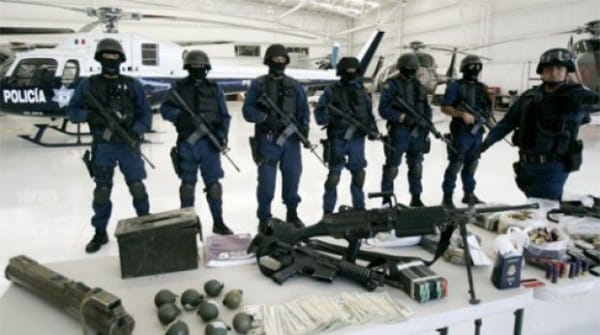
The leaders will meet on November 27 in Washington, DC and, although an official agenda has not been released, it is likely that the new Mexican president will use the opportunity to propose renewed efforts to combat drug trafficking. The fight against drug cartels has eluded outgoing Mexican President Felipe Calderon and has claimed the lives of more than 60,000 people during Calderon’s six year term.
Luis Videgaray, as well as other high-level politicians, have taken notice of the recent changes in US law concerning marijuana regulation.
In a radio interview in Mexico City, Videgaray stated “Obviously, we can’t handle a product that is illegal in Mexico, trying to stop its transfer to the United States, when in the United States, at least in part of the United States, it now has a different status. I believe this obliges us to think the relationship in regards to security ... This is an unforeseen element.”
Echoing the concern to undermine the drug trade, the Governor of the Mexican State of Chihuahua, Cesar Duarte stated:
“It seems to me that we should move to authorize exports. We would therefore propose organizing production for export, and with it no longer being illegal, we would have control over a business which today is run by criminals. And which finances criminals.”
Peña Nieto has said that he is against a wholesale national legalization of marijuana, but shortly after his election stated that he would be open to debating the issue.
A study by a Mexican think tank estimated that legalization of marijuana in Colorado and Washington represents over $3 billion worth of the drug trade. Much of that study is presumed, however, upon the assumptions that consumers would opt for cheaper, domestically grown marijuana and that the US government would not aggressively investigate and prosecute movement of marijuana out of a state where it's legal.
For its part, the US Justice Department has released a statement on the new Colorado and Washington laws saying:
“The department’s enforcement of the Controlled Substances Act remains unchanged. In enacting the Controlled Substances Act, Congress determined that marijuana is a Schedule 1 controlled substance. We are reviewing the ballot initiatives and have no additional comment at this time.”
The Obama administration was vocal in its efforts to halt a similar, although failed, attempt to fully legalize marijuana consumption. Attorney General Eric Holder has actively enforced federal law in California, filing court papers to seize properties rented to medical marijuana sellers and threatening to shut down sixty-seven dispensaries in Los Angeles alone.
Responses from local US political leaders on Mexico’s efforts to address the drug trade have been mixed. In 2006, when Mexico City began its own discussions to legalize drugs as a form of undermining the economics of the drug trade, then Mayor of San Diego, Jerry Sanders called the law, “appallingly stupid, reckless and incredibly dangerous,” and added “I view this as a hostile action by a longtime ally of the U.S.”
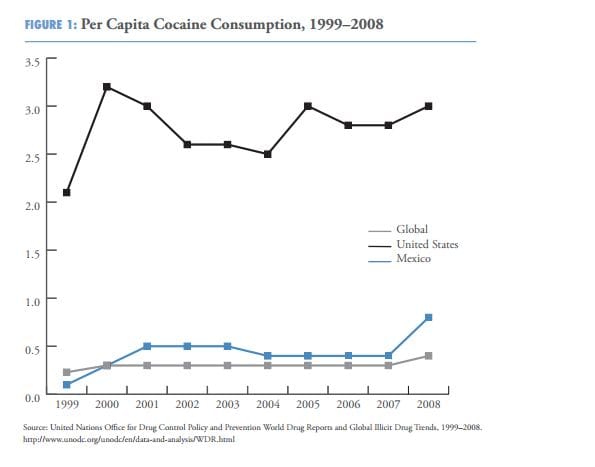
The United States and Mexico have mutual concerns as drug use has increased in both countries. And it may be that the legalization of marijuana may only pave the way for other illicit drug trade. According to a 2010 US government survey, marijuana was the most commonly used drug in the US, with more than 17 million users in 2010, 3 million more than in 2007. Cocaine usage is on a steady decline in the US, however, one and a half million people still consumed the drug in 2010.
Mexican use of cocaine has risen in the past few years, signaling that perhaps the drug war will continue, but shift towards battles over the import and export a different consumable.
The incoming President of Mexico's policy with respect to combating narco trafficking is markedly different than his predecessor. He opposes the presence of US troops in Mexico, opting instead to continue drone strikes and counter-intelligence operations so long as they are carried out by Mexican troops. Also in contrast to Calderon, rather than attempting to dismantle drug organizations from the top-down, he has stated that the focus of his administration's security apparatus would be to curb street-level violence rather than arresting and killing top drug traffickers and carrying out drug seizures heading to the world's largest drug consumer, the United States.