
Voter ID Constitutional Amendment bill opponents. Credit: Jeff Wheeler / Star Tribune
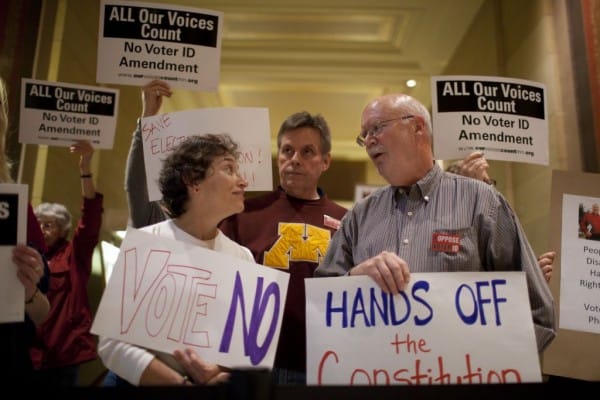
The Minnesota Supreme Court ruled last Monday that a Minnesota voter ID law will remain on the ballot as worded.
In the 4-2 ruling the court decided, "the 'essential purpose' of the proposed amendment at issue in this case is the requirement that voters provide photographic identification in order to vote. That 'essential purpose' is communicated in the ballot question." But Justice Alan Page came out and said that the language of the ballot question “deliberately and materially misstated the language of the proposed amendment.” He called it "a classic bait and switch."
The Minnesota voter ID law has split the state along party lines, similar to the rest of the nation, leaving the ultimate decision up to voters in the November 6 general elections.
Sen. Scott Newman (R-Hutchinson), the author of the bill, said he plans to follow the ruling in Indiana's Crawford v. Marion County Election Board case as a template. "If you follow Crawford when you're drafting this legislation, I really think you're going to be OK," Newman said. "The U.S. Supreme Court has already put their stamp of approval on it." Newman said his intent with the bill was to end the practice of “vouching”.
Minnesota voters are currently able to register on Election Day by using a variety of methods to prove their identification. A citizen of 18 years or older can use items such as a college ID, tribal ID or telephone bill to prove residency or a witness can swear under oath to verify another citizen’s address, also known as “vouching.”
This flexibility in identification has proponents of the proposed amendment to Article VII, Section 1 of the Minnesota Constitution worried it acts as a breeding ground for voter fraud. As of January, there were 215,389 registered voters who did not have a valid Minnesota driver’s license or identification card. The amendment promises to provide free IDs to eligible voters to prevent fraud.
Mayors Chris Coleman of St. Paul and R.T. Rybak of Minneapolis (both members of the Democratic-Farmer-Labor Party) believe that the law will disenfranchise voters and cost their cities money they could be spending elsewhere.
"This is a terrible amendment that is not only an attempt to restrict voting, on the parts of seniors, on the parts of students, it is I think a cynical political ploy, quite frankly, that seeks to undo 40 years of Minnesota being one of the most forward-thinking states in terms of voter eligibility, in terms of getting people out to vote," Coleman said.
This debate is essentially over Republican-favored election security and Democratic-preferred ballot access. "If this passes, I think we will have many years of litigation and possibly many lawsuits," said state Rep. Steve Simon (DFL-St. Louis Park).
One House member, Sen. Jeremy Miller (R-Winona), crossed party lines in opposing the bill. After the vote, Ritchie said, "Independent voters in general are very suspicious, when something is strictly a partisan battle, they smell a rat somewhere."