Skip to content
Sign up free
News

Neil Armstrong Advocated for Greater US Presence in Space

Neil Armstrong Advocated for Greater US Presence in Space

By Brian Nicewander

2-minute read

(Photo Credit: NASA)
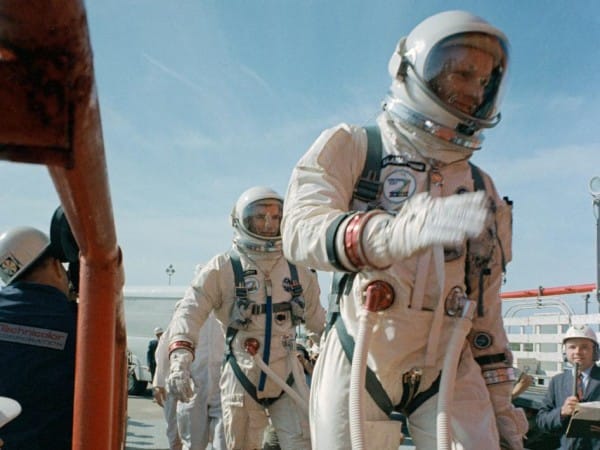
Neil Armstrong, the first human to walk on the moon, died of complications from heart surgery on Saturday. Armstrong began his path to the moon as a naval aviator serving in the Korean War. He later became a test pilot flying experimental aircraft. The astronaut was the first to successfully dock two craft in space in 1966.

Armstrong commanded Apollo 11, which left Cape Kennedy, Florida on July 16, 1969. Armstrong and fellow astronauts Michael Collins and Edwin 'Buzz' Aldrin came to orbit the moon on July 20. Armstrong manually landed the Eagle lunar model onto the surface and was the first to ever set foot on the moon.

Armstrong remained a long-time advocate for NASA programs later in life and a greater US presence in space. In 2010, the astronaut criticized President Obama's budget cuts to the space agency telling the Senate:

"If the leadership we have acquired through our investment is simply allowed to fade away, other nations will surely step in where we have faltered.”

NASA funding has steadily decreased since the end of the Cold War that pitted the United States against the Soviet Union for dominance in space. The president's 2013 budget calls for additional cuts to NASA including reductions in planetary science funding at the NASA Jet Propulsion Laboratory in California.

The JPL landed the rover, Curiosity, on the surface of Mars in August. NASA launched the $2.5 billion project to investigate whether conditions favorable for life have ever existed on the red planet. NASA hopes that Curiosity will allow scientists to travel to previously unreachable destinations on Mars.

Recently, California Senator Diane Feinstein told scientists on a visit to the laboratory:

"I can't say that JPL isn't going to feel the belt-tightening that's going on."

Feinstein said that she supported a proposal to return $100 million to the JPL budget, but that she did not expect progress on the deal until after this year's elections.

House Republican lawmakers proposed cuts to NASA above the White House’s reductions in a separate budget earlier this year. The Republican plan would cut NASA by $379 million. However, in February the Orlando Sentinel reported that the cuts would more likely reach $103 million because House Republicans utilized the president’s funding request for 2011 in their calculations. A spokesperson for the House Appropriations Committee told the paper that the Republican plan would end up cutting NASA by $103 million next year.

In July, legislators reached an agreement to continue to fund the federal government at current levels through March 2013. The congress will not take up a new budget before the 2012 elections.

Tags: News

Adhere to the IVN etiquette

By posting a comment, you agree to adhere to our etiquette rules: No partisan attacks, no personal attacks, substantiate your sources, no self-promotion.

Get IVN’s Free Weekly Newsletter:Get IVN’s Free Newsletter

Get IVN’s Free Weekly Newsletter:Get IVN’s Free Newsletter

Nonpartisan Issues. Diverse Perspectives.

Check your inbox and click the link to confirm.

Republish this article

Republishing guidelines

Republish IVN articles for free. Independent Voter News articles may be republished online or in print under a Creative Commons BY-NC-ND 4.0 license, on these terms:

  1. Credit the author and IVN. Keep the byline ("By Author Name, Independent Voter News") and the attribution note at the end, which links to the original.
  2. Keep the meaning. You may update time and place references and apply your house style. You may trim for length, as long as the cuts don't change the meaning or misrepresent the author. Keep the headline. Mark any additions as your own (for example "Additional reporting by ...").
  3. Translations are welcome. Translate faithfully, add "Translated from English by [your outlet]", and tell us at editor@ivn.us.
  4. Keep the links, including the link to the original article.
  5. Keep the tracking image. The HTML includes a 1-pixel image that counts readers on your page. It collects no personal information.
  6. Photos and illustrations. Images credited to IVN may be used with this article only. Images credited to others (AP, Getty, Unsplash, Wikimedia and so on) stay under their owners' terms. Secure the rights or switch "Include images" off.
  7. Don't sell it. You can't sell our articles or sell ads specifically against them. Your normal site advertising is fine.
  8. No implied endorsement. Don't suggest that IVN or the author endorses you, your candidates or your causes, or that donations to you support IVN.
  9. Keep labels. Opinion or analysis pieces keep that label.
  10. Point search engines to the original. Set the canonical URL of your copy to the original IVN article (the HTML we give you includes the tag).
  11. No bulk or automated republishing, and don't submit our articles to aggregators (Apple News, Google News, MSN) as your own.
  12. Corrections and removals. Update your copy when we correct it, and remove it promptly if we ask. We'll contact you at the email you give us.
  13. Questions or print republication: editor@ivn.us.

IVN staff: fill in who you're inviting above, then create the invite.

Preparing the article

Neil Armstrong Advocated for Greater US Presence in Space

Choose a format
  • HTML
  • Email HTML
  • Markdown
  • Formatted (.docx)
  • Plain text
  • WordPress blocks
  • PDF
Choose a platform

Photos credited to others need their owners' permission.

To for

Republishing somewhere else? Questions? editor@ivn.us