Skip to content
Sign up free
News

Americans Believe Their Wages Have Gone Up in Past 5 Years

Americans Believe Their Wages Have Gone Up in Past 5 Years

By Brian Iniguez

2-minute read

It has been five years since the economic crisis of 2008. A recent Gallup poll conducted in August shows that 58 percent of Americans working full time or part time believe they are making markedly higher amounts of money. The poll did not define what "a lot" or "a little" meant, but left it up to the respondent to decide for themselves. In other words, people differ in what "a lot" of money is.

The results show a divide in public perception. Roughly the same amount of people who think they are making either a lot more money or a little more (28 and 30 percent, respectively) also believe they are making less. 14 percent of people haven't seen any change at all. Those figures combined mean that 42 percent of Americans are feeling the lasting effects of the 2008 recession and are getting paid the same or less since then. A graph depicting the Average Wage Index (AWI). Via Social Security.
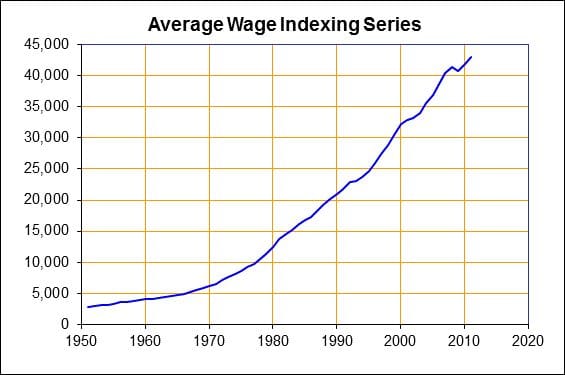
A graph depicting the Average Wage Index  (AWI). Via Social Security and minimum wage

Perceptions aside, the average salary has slowly recovered since 2008, the national average having increased to $47,000 from $41,000 in '08.

The split in opinion over wages could have something to do with age. Older citizens tend to believe  their salaries are higher than five years ago. Fifty-nine percent of people aged 30 - 49 agreed they felt their pay had increased, and 45 percent of 50 - 69 year olds thought the same.

The 18-29 age bracket was even more likely to say they were making "a lot more" in funds, over half. However, many within this age group work minimum wage jobs.

About half of all workers with an hourly wage were under 25 in 2012, and have no prior salary to compare it to. That doesn't mean that they are making a lot more money. It's their perception of finally having an income that could influence their response. Minimum wage isn't enough to live on. Indeed, fast food workers in New York gathered in protest of their low salaries.

Even so, Gallup took workers with no prior salary into account:

"51% of 23- to 29-year-olds say they are making a lot more and 22% are making a little more."

In a nation where 16.1 percent of young people are unemployed, and only one in ten college students are receiving federal work study, they may be experiencing the same excitement as they would have had at 18. With the increasing national ambivalence of the national minimum wage, legislation could bump that figure up even more, leading to a faster economic recovery.

Photo Credit: vitma / Shutterstock

Tags: News

Adhere to the IVN etiquette

By posting a comment, you agree to adhere to our etiquette rules: No partisan attacks, no personal attacks, substantiate your sources, no self-promotion.

Get IVN’s Free Weekly Newsletter:Get IVN’s Free Newsletter

Get IVN’s Free Weekly Newsletter:Get IVN’s Free Newsletter

Nonpartisan Issues. Diverse Perspectives.

Check your inbox and click the link to confirm.

Republish this article

Republishing guidelines

Republish IVN articles for free. Independent Voter News articles may be republished online or in print under a Creative Commons BY-NC-ND 4.0 license, on these terms:

  1. Credit the author and IVN. Keep the byline ("By Author Name, Independent Voter News") and the attribution note at the end, which links to the original.
  2. Keep the meaning. You may update time and place references and apply your house style. You may trim for length, as long as the cuts don't change the meaning or misrepresent the author. Keep the headline. Mark any additions as your own (for example "Additional reporting by ...").
  3. Translations are welcome. Translate faithfully, add "Translated from English by [your outlet]", and tell us at editor@ivn.us.
  4. Keep the links, including the link to the original article.
  5. Keep the tracking image. The HTML includes a 1-pixel image that counts readers on your page. It collects no personal information.
  6. Photos and illustrations. Images credited to IVN may be used with this article only. Images credited to others (AP, Getty, Unsplash, Wikimedia and so on) stay under their owners' terms. Secure the rights or switch "Include images" off.
  7. Don't sell it. You can't sell our articles or sell ads specifically against them. Your normal site advertising is fine.
  8. No implied endorsement. Don't suggest that IVN or the author endorses you, your candidates or your causes, or that donations to you support IVN.
  9. Keep labels. Opinion or analysis pieces keep that label.
  10. Point search engines to the original. Set the canonical URL of your copy to the original IVN article (the HTML we give you includes the tag).
  11. No bulk or automated republishing, and don't submit our articles to aggregators (Apple News, Google News, MSN) as your own.
  12. Corrections and removals. Update your copy when we correct it, and remove it promptly if we ask. We'll contact you at the email you give us.
  13. Questions or print republication: editor@ivn.us.

IVN staff: fill in who you're inviting above, then create the invite.

Preparing the article

Americans Believe Their Wages Have Gone Up in Past 5 Years

Choose a format
  • HTML
  • Email HTML
  • Markdown
  • Formatted (.docx)
  • Plain text
  • WordPress blocks
  • PDF
Choose a platform

Photos credited to others need their owners' permission.

To for

Republishing somewhere else? Questions? editor@ivn.us