
This spring, a wide range of issues dominated American political discussion, from gun law reform to North Korea, from immigration to gay rights. Yet, a very important subject has escaped notice: nuclear arms reductions. In his 2013 State of the Union address, President Obama said that "we will engage Russia to seek further reductions in our nuclear arsenals." Since then, there has been very little public dialogue about the matter, despite its immense importance.
Douglas Guarino of the Nuclear Threat Initiative reported that for 2013 alone, "the administration requested $7.6 billion for National Nuclear Security Administration programs aimed at maintaining a 'safe, secure and effective nuclear deterrent.'" Clearly, America's nuclear weapons program is militarily pivotal, but it is also fiscally significant, as Guarino and others indicate. The reasons for and against reducing such an arsenal are many. This article will try to summarize a few of those points.
To begin, arsenal reductions are a touchy subject politically. According to an early March Gallup poll, 56% of Americans favor a reduction of U.S. and Russian arsenals, while 38% disagree. Among independents specifically, the margin is even wider (57% to 36%). However, the Obama administration has demonstrated immense caution in this area, despite the overall support for reductions. On Feb. 10, David Sanger of the New York Times reported the following:
"The nuclear reduction plan has been debated inside the administration for two years, and the options have been on Mr. Obama's desk for months. But the document was left untouched through the presidential election."
Why the caution? If reductions are supported by a 56% majority, then why doesn't the president work tirelessly to accomplish them? Guarino of the Nuclear Threat Initiative writes Doug Mills/The New York Times
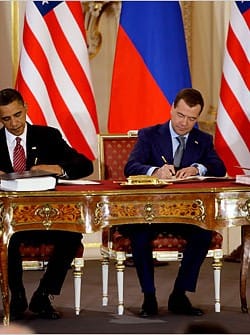
that "Capitol Hill Republicans are threatening to block any possible attempts by the Obama administration to obtain further nuclear arms reductions without congressional approval." Now, the president's opponents may be initially using a "balance of power" argument to oppose arsenal reductions (and they may very well by right), but what are some other points against reduction?
On Feb. 12, Baker Spring of the Heritage Foundation presented what seems to be the overall case against cutting quantities of American nuclear weapons. It goes as follows:
"Even under New START it is clear that Russia will achieve overall nuclear superiority over the U.S., which will undermine the long-standing U.S. policies for extended nuclear deterrence and assurance for the protection of U.S. allies."
The argument seems simple: less nuclear weapons would mean less power for the United States. But, there are still some who disagree. How many nuclear weapons do we really need?
In the Bulletin of Atomic Scientists, Kingston Reif from the Center for Arms Control and Non-Proliferation wrote that "further nuclear weapons reductions are squarely in the national interest." He went on to argue that "the continued U.S. maintenance of thousands of nuclear weapons is not necessary to deter the nuclear threats our allies face today." Now, Reif also makes an economic point. Wouldn't reducing our nuclear arsenal also save money? Here's Reif's answer:
"The Pentagon and Energy Department are planning to spend hundreds of billions of dollars over the next decade to build new delivery systems and warhead production facilities. Reductions would stem the need for a significant amount of this spending."
The details of Reif's fiscal claims and Spring's strategic claims can be discussed elsewhere. What we should summarize from both is this: nuclear arsenal reductions will mean that the U.S. saves money, but might lose some clout. So, should President Obama choose to risk cutting back on nuclear weapons, or should he instead just continue to pay for the entire arsenal, some of which we may not even need? Should he risk, or should he waste?