Skip to content
Sign up free
News

Paying More for Less? Interest Expenses Rise

Paying More for Less? Interest Expenses Rise

By State Data Lab

2-minute read

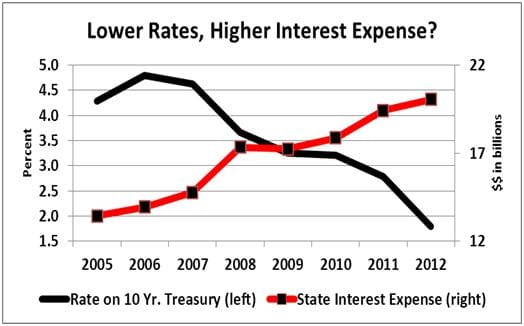
State interest expenses have risen even as interest rates have fallen.
RiseFall

It’s general knowledge that falling interest rates help debtors.  As long as a loan can be refinanced at a new, lower rate, a debtor can expect lower payments.

Then what’s going on with the fifty states?

Interest rates have been falling significantly since 2007, but the cumulative interest expense of the states has been steadily marching higher anyway.

From fiscal 2005 to 2012, total interest expense reported by the 50 state governments more than doubled, even as the 10-year Treasury rate fell by two-thirds. (Note: we estimated New Mexico interest expense for its June 2012 fiscal year.  As of August 2, 2013, New Mexico still hasn’t reported its 2012 results.)

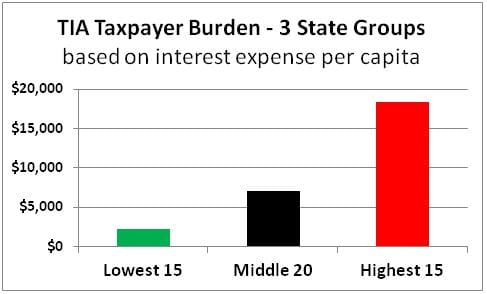
The fifty states are far from equal on this matter, however.  One way to compare the states is to examine their interest expense per capita. After investigation, it soon becomes apparent that the “rising interest expense amidst falling interest rates” story is concentrated in states with higher interest expense per capita.  Those states also tend to carry higher Taxpayer Burdens, as estimated by Truth in Accounting.

The chart below shows the average TIA Taxpayer Burden for three different groups of states, which are grouped by the average interest expense per capita from 2005 to 2012.  States with higher interest expense also have higher Taxpayer Burdens. The states with the highest interest expense per capita also have poor fiscal health.
TIAVsInterest

Many states have apparently not been able to benefit of low interest payments, as debt levels have increased and the spreads for rates paid by challenged states have widened over base rates.  While some states have established hedges in derivative instruments, this still highlights the risk of a possible further spike in interest expenses if rates bounce back up.

Moreover, this danger lurks primarily in the states with unhealthy fiscal positions—the last states to need any more financial difficulties heaped on them.

Where does your state stack up in this picture?  You can quickly find this information and more using State Data Lab.

Tags: News

Adhere to the IVN etiquette

By posting a comment, you agree to adhere to our etiquette rules: No partisan attacks, no personal attacks, substantiate your sources, no self-promotion.

Get IVN’s Free Weekly Newsletter:Get IVN’s Free Newsletter

Get IVN’s Free Weekly Newsletter:Get IVN’s Free Newsletter

Nonpartisan Issues. Diverse Perspectives.

Check your inbox and click the link to confirm.

Republish this article

Republishing guidelines

Republish IVN articles for free. Independent Voter News articles may be republished online or in print under a Creative Commons BY-NC-ND 4.0 license, on these terms:

  1. Credit the author and IVN. Keep the byline ("By Author Name, Independent Voter News") and the attribution note at the end, which links to the original.
  2. Keep the meaning. You may update time and place references and apply your house style. You may trim for length, as long as the cuts don't change the meaning or misrepresent the author. Keep the headline. Mark any additions as your own (for example "Additional reporting by ...").
  3. Translations are welcome. Translate faithfully, add "Translated from English by [your outlet]", and tell us at editor@ivn.us.
  4. Keep the links, including the link to the original article.
  5. Keep the tracking image. The HTML includes a 1-pixel image that counts readers on your page. It collects no personal information.
  6. Photos and illustrations. Images credited to IVN may be used with this article only. Images credited to others (AP, Getty, Unsplash, Wikimedia and so on) stay under their owners' terms. Secure the rights or switch "Include images" off.
  7. Don't sell it. You can't sell our articles or sell ads specifically against them. Your normal site advertising is fine.
  8. No implied endorsement. Don't suggest that IVN or the author endorses you, your candidates or your causes, or that donations to you support IVN.
  9. Keep labels. Opinion or analysis pieces keep that label.
  10. Point search engines to the original. Set the canonical URL of your copy to the original IVN article (the HTML we give you includes the tag).
  11. No bulk or automated republishing, and don't submit our articles to aggregators (Apple News, Google News, MSN) as your own.
  12. Corrections and removals. Update your copy when we correct it, and remove it promptly if we ask. We'll contact you at the email you give us.
  13. Questions or print republication: editor@ivn.us.

IVN staff: fill in who you're inviting above, then create the invite.

Preparing the article

Paying More for Less? Interest Expenses Rise

Choose a format
  • HTML
  • Email HTML
  • Markdown
  • Formatted (.docx)
  • Plain text
  • WordPress blocks
  • PDF
Choose a platform

Photos credited to others need their owners' permission.

To for

Republishing somewhere else? Questions? editor@ivn.us