
In a recent report published by Pew Research Center, Lee Rainie and Aaron Smith discuss the correlation between politics and social media as a part of Pew's larger “Internet & American Life Project.” As one of the seven projects of Pew, the "Internet & American Life Project" focuses on “the issues, attitudes and trends shaping America and the world.” In their most recent publication entitled “Politics on Social Networking Sites,” surveys reveal the prevalence and importance placed on political activities in social networking sites (SNS).
Statistics on the survey are summarized as so:
These are the findings from a survey conducted from January 20-February 19, 2012 among 2,253 adults ages 18 and older, including 901 cell phone interviews. Interviews were conducted in English and Spanish. The margin of error for the full sample is plus or minus 2.3 percentage points. And the margin of error of the sample dealing with social network site users (n=1,407) is plus or minus 2.9 percentage points.
A crucial aspect to note, however, is that this survey was conducted during the months of January and February. While the Republican primary was underway during this time, the overall use of social networking sites in the months leading up to the general election might reflect a more accurate view of the importance of social media in politics. Citizens tend to tune in to politics during the months closest to the general election, when party conventions, presidential debates, and campaign ads dominate the national airwaves. Therefore, the likelihood of networkers to post politically charged updates increases the closer we get to the election. This spike in usage, however, could be based on context and may not change the overall conclusion that political postings on social networks are low.
Unsurprisingly, young adults (ages 18-29) on social networking sites are more likely to say SNS are important for politics. Forty-one percent say that SNS are important for keeping up with political news and 36% place importance on their ability to recruit people to get involved with political issues that matter to them. Barack Obama's victory in the 2008 election is attributed in part to his appeal to young voters, which was arguably fueled by his strong command of social media.
The main findings of the survey paint a grim picture of public perception on politics in social media, showing the overall low occurrence of political postings on SNS and the low impact of SNS on users’ political views.
- 25% of SNS users say they have become more active in a political issue after discussing it or reading posts about it on the sites.
- 16% of SNS users say they have changed their views about a political issue after discussing it or reading posts about it on the sites.
- 9% of SNS users say they have become less involved in a political issue after discussing it or reading posts about it on the sites.
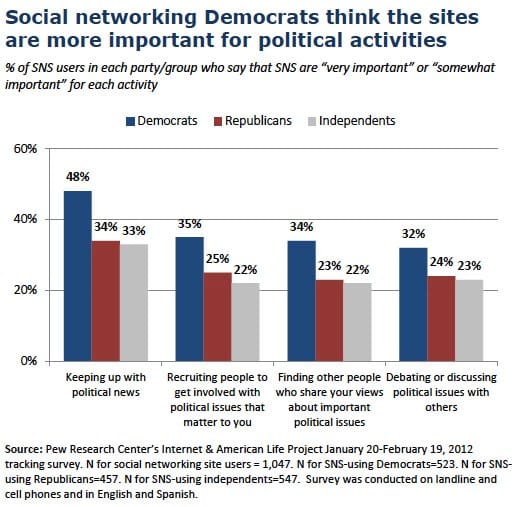
Although the conclusions of the survey are unavoidably valuable in looking at the relationship between politics and SNS, the study ignores the progress and potential of social media to actually play a larger and more important role in politics in the future.
Social networking sites were created to, as it's rightly labeled, network. But as seen on the Social Ballot, the social media world is experiencing innovations by political platforms, politicians, political parties, research groups, and social media sites, creating a place for politics to have a greater role in social networking. Innovations such as Votizen or Youtube’s Election Hub are examples of platforms paving the way for the inclusion of politics in social networking. In time, this can positively change the relationship between SNS and politics.
Also not surprising is the conclusion that “those who are quite politically attuned use social networking sites differently and get more out of them.” It can be argued that political engagement is based on more of a macro-cultural premise and social networking allows users to post on topics important to them. The low prevalence of political related posts (with 84% of SNS users reporting that they have ‘posted little or nothing related to politics in their recent status updates, comment, and links) could alternatively indicate that the U.S. is experiencing increased political apathy. Another alternative explanation could be that passions and deeply individual aspects surrounding the realm of politics make people uncomfortable with expressing their political beliefs on social networking sites.
Although it may be an idealist thought, wouldn't the greater social frustrations that Americans are feeling warrant an outlet for political discussion? Why not embrace the idea of using social networking sites as this outlet, in hopes of encouraging a more informed electorate.