Skip to content
Sign up free
News

Potential Presidential Appointments: Who is Susan Rice?

Potential Presidential Appointments: Who is Susan Rice?

By Marc Schenker

2-minute read

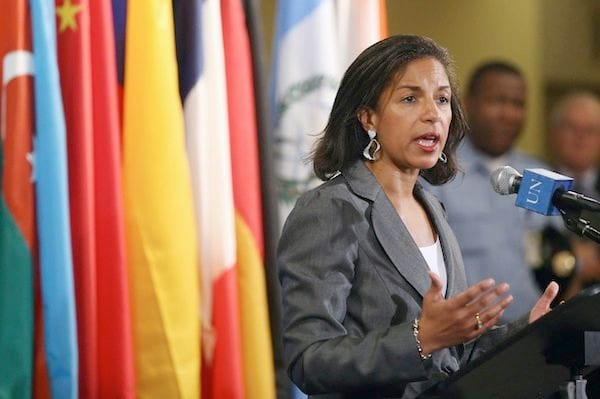
Photo: Mario Tama

Many Americans associate UN Ambassador Susan Rice with the potential misinformation that she provided about the Benghazi terror attacks on five Sunday talk shows. However, before her recent thrust into national controversy, Rice was a long-serving bureaucrat in the Clinton administration during the 1990s, making her integral to Democrat policies and objectives. Rumored to be a potential candidate as the next Secretary of State, Rice has outraged prominent Republicans like Senator John McCain, who has already pledged to block her potential nomination.

Prior to settling on politics and public policy as her career choice, she was a student at Stanford University, where she was elected to Phi Beta Kappa, an honor society. After graduating from Stanford in 1986 with a B.A. in history, she studied at New College, Oxford, on a Rhodes Scholarship, earning a Doctor of Philosophy in 1990. She married Ian Officer Cameron, an ABC News producer, in 1992.

Long before Benghazi, Rice served in many positions in the Clinton administration. From 1993 to 1997, she served at the National Security Council. From 1993 to 1995, she served as Director for International Organizations and Peacekeeping and, from 1995 to 1997, as Senior Director for African Affairs and Special Assistant to the President.

Her role in the Clinton administration was marked by ups and downs. She had received criticism by prominent figures, including Timothy M. Carney, former Ambassador to Sudan, David Rose, Vanity Fair contributing editor, and Richard Miniter, an investigative journalist. The criticism focused on Rice’s reported central role in rejecting an offer from Sudan to turn over Osama bin Laden to the US in 1996. However, as assistant secretary for African affairs, she developed a detailed and extensive knowledge on Al Qaeda and its African operations, as well as reputation for effective negotiation and communication with other nations.

After George W. Bush came into office in 2001, Rice worked in the private sector; first with Intellibridge, a strategic analysis company, and then with the Brookings Institute in 2002. In 2004, she returned to politics by working as foreign policy advisor to John Kerry’s presidential campaign.

Rice ingratiated herself with then-Senator Barack Obama by working as a foreign policy advisor in the 2008 Obama presidential campaign. After his election, Rice was nominated as UN Ambassador, the position she still holds today. Her possible nomination to Secretary of State, replacing outgoing Secretary Hillary Clinton, is an indication of the high esteem she still holds in the president’s view. Despite the Benghazi controversy, Rice is seen by the president as a reliable choice to replace Clinton because of her years of government service, her Clinton-era post as assistant secretary of state for African Affairs, and her four years as UN ambassador.

Tags: News

Adhere to the IVN etiquette

By posting a comment, you agree to adhere to our etiquette rules: No partisan attacks, no personal attacks, substantiate your sources, no self-promotion.

Get IVN’s Free Weekly Newsletter:Get IVN’s Free Newsletter

Get IVN’s Free Weekly Newsletter:Get IVN’s Free Newsletter

Nonpartisan Issues. Diverse Perspectives.

Check your inbox and click the link to confirm.

Republish this article

Republishing guidelines

Republish IVN articles for free. Independent Voter News articles may be republished online or in print under a Creative Commons BY-NC-ND 4.0 license, on these terms:

  1. Credit the author and IVN. Keep the byline ("By Author Name, Independent Voter News") and the attribution note at the end, which links to the original.
  2. Keep the meaning. You may update time and place references and apply your house style. You may trim for length, as long as the cuts don't change the meaning or misrepresent the author. Keep the headline. Mark any additions as your own (for example "Additional reporting by ...").
  3. Translations are welcome. Translate faithfully, add "Translated from English by [your outlet]", and tell us at editor@ivn.us.
  4. Keep the links, including the link to the original article.
  5. Keep the tracking image. The HTML includes a 1-pixel image that counts readers on your page. It collects no personal information.
  6. Photos and illustrations. Images credited to IVN may be used with this article only. Images credited to others (AP, Getty, Unsplash, Wikimedia and so on) stay under their owners' terms. Secure the rights or switch "Include images" off.
  7. Don't sell it. You can't sell our articles or sell ads specifically against them. Your normal site advertising is fine.
  8. No implied endorsement. Don't suggest that IVN or the author endorses you, your candidates or your causes, or that donations to you support IVN.
  9. Keep labels. Opinion or analysis pieces keep that label.
  10. Point search engines to the original. Set the canonical URL of your copy to the original IVN article (the HTML we give you includes the tag).
  11. No bulk or automated republishing, and don't submit our articles to aggregators (Apple News, Google News, MSN) as your own.
  12. Corrections and removals. Update your copy when we correct it, and remove it promptly if we ask. We'll contact you at the email you give us.
  13. Questions or print republication: editor@ivn.us.

IVN staff: fill in who you're inviting above, then create the invite.

Preparing the article

Potential Presidential Appointments: Who is Susan Rice?

Choose a format
  • HTML
  • Email HTML
  • Markdown
  • Formatted (.docx)
  • Plain text
  • WordPress blocks
  • PDF
Choose a platform

Photos credited to others need their owners' permission.

To for

Republishing somewhere else? Questions? editor@ivn.us