
Photo: Ben Schumin/Wikipedia Commons
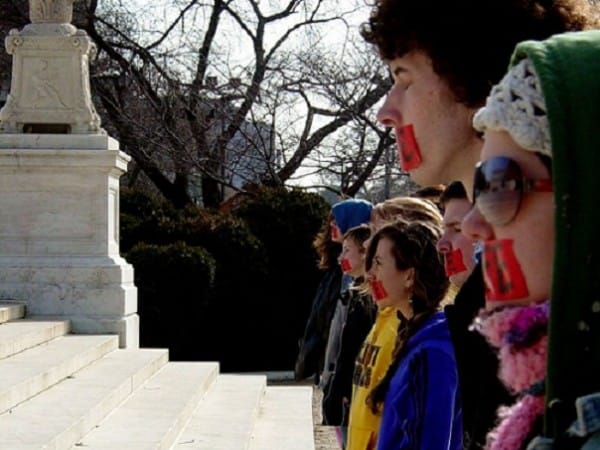
Women's Rights Continues to be a Wedge Issue
The notion of a "big tent" coalition is a thought that takes extreme precedence in the current two-party state that dominates American democracy. Building a political coalition, for Democrats and Republicans, becomes a high-wire tightrope walk which requires subtlety, nuance, and persuasion. An example of that balancing act pertains to President Barack Obama and his down-ticket colleagues, who are tasked with juggling the interests of both Pro-Choice and Pro-Life Democrats to produce a triumphant ticket. The question then becomes whether the recent focus on women's rights within the Democratic Party will result in a wider electorate or turn off key voters, particularly moderate faith-based voters?
The issue of contraceptive rights has often been a lighting rod for criticism during an election year, in which the parties comb through issue-based voting groups to strike the right chords that will build a piecemeal coalition.
This year, the issue of women's rights -- more precisely, access to contraceptives and the government's role -- has become a cause célèbre within several Democratic political campaigns. This was evident by the role pro-choice activists played during the Democratic National Convention.
Planned Parenthood President Cecile Richards delivered a speech on the issue that elicited several loud applause breaks. She was joined by activist Sandra Fluke and Massachusetts Senatorial candidate Elizabeth Warren, who both echoed similar remarks on the issue.
This motif has been furthered in recent weeks by the Obama/Biden campaign, which has sent several prominent female associates onto the campaign trail to discuss the issue, while it largely stayed away from the contentious topic. The weekend of September 15 saw Second Lady Jill Biden and DNC chairwoman Debbie Wasserman-Schultz articulate their views.
However, the Obama camp's use of surrogates, and not themselves, to drum up support for the issue, also, highlights the inherent dangers of treading too far into contentious issues at a time in which campaigns are looking to build broad appeal. Too much an emphasis could ultimately alienate religious-based voters. One such example is Catholic voters, who historically have been a key cornerstone of the Democratic bloc. However, that relationship has shown signs of fraying in recent years, and in fact, came unglued in 2004, when President George W. Bush pulled a historic upset by winning the Catholic vote from Senator John Kerry. Numerous Catholics listed the issue of abortion as the reason for their defection.
Now, several Pro-Life advocates are hoping that the same subject could once again strike a chord among religious based voters. In a recent Op-Ed, posted at The Daily Caller, Daniel McConchie, Vice President of Americans United for Life, expounded on his belief that the Democratic Party is no longer welcome to those who consider themselves Pro-Life. McConchie stated, "Anti-abortion Democrats have become an endangered species on Capitol Hill as well as in governors’ offices across the country. Anti-abortion Democrats in state legislatures complain that the national party actively blocks their efforts to move up the ranks, instead favoring those who toe the party’s radical line on abortion."
He would continue to elaborate on several prominent examples of, what he deems to be, snubs to pro-life Democrats. "The 2012 Democratic platform supports taxpayer-funded abortion on demand during all nine months of pregnancy, for any reason whatsoever," McConchie stated.
If McConchie is accurate in his assessment that the Democratic Party risks losing faith-based voters, who are concerned with the issue , then, that would likely serve as a stark blow to Democratic chances in several swing states, where those voters historically held sway in determining the eventual winners of statewide elections.
Despite the risks, numerous pro-choice advocates believe the moral imperative outweighs those concerns. Angela Ferrell-Zabala, of the Religious Coalition for Reproductive Choice, states that the issue has taken a "front and center" roll, and that it stems from the frustration that voters feel from the rhetoric of the 2010 election cycle, "Promises were made on the economy and jobs, and then when they're elected, they turnaround and launch an attack on women's issues."
Ferrell-Zabala also believes that pro-life political and religious leaders are incorrectly melding the issue of contraceptives and religious affiliation, stating that favoring greater access to reproductive rights is not a disqualifier to being a congregant of any faith.
She is backed by Jon O'Brien, President of Catholics for Choice, which advocates many of the same positions. "One of the great American tragedies is the fact that reproductive health has becomes the hostage of political parties," stated O'Brien. "The demonization of services, the unbelievable attacks we've seen on contraception, in the last couple of months, really does damage to the institution of individual rights that we have in this country."
He, like Ferrell-Zabala, believe that the notion of a pro-life ideology being synonymous with religious belief has been established by politically-motivated religious leaders who are skewing the true tenets of their faith.
Ultimately, the issue appears to have legs and could play a prominent roll in several key races where candidates will seek to siphon off votes from traditional opposition bases. The Democrats seek to continue the delicate balancing act of appealing to women voters. Meanwhile, the Republicans will find it advantageous to use the topic as a wedge issue, hoping to usurp decades-long Democratic electoral relationships. Add in the uncertainty of the economy, which threatens to overshadow all social issues in this election, and a recipe for an uncertain election day looks quite feasible.