
Skip to content
Sign up free
Campaigns

Research Shows Congress Is Getting Younger, But No Less Divided

Research Shows Congress Is Getting Younger, But No Less Divided
Photo by Katelyn Perry on Unsplash+. Unsplash+ license obtained by author.

Pew Research Center published 7 facts this week about the changing face of Congress in the 119th session. On top of an increase in diversity, the research center found Congress is also slightly younger.

By Shawn Griffiths

2-minute read

Pew Research Center published 7 facts this week about the changing face of Congress in the 119th session. On top of an increase in diversity, the research center found Congress is also slightly younger.

Pew's data shows that the median age of the 119th Congress is 57.5 in the House (among voting members), compared to 57.9 at the start of the 118th Congress two years ago. So, it’s younger – but not by much.

The 119th Congress also marks the first time in recent congressional sessions members in the Baby Boomer generation don't make up a majority or a plurality. Gen X members make up 41% of the US House.
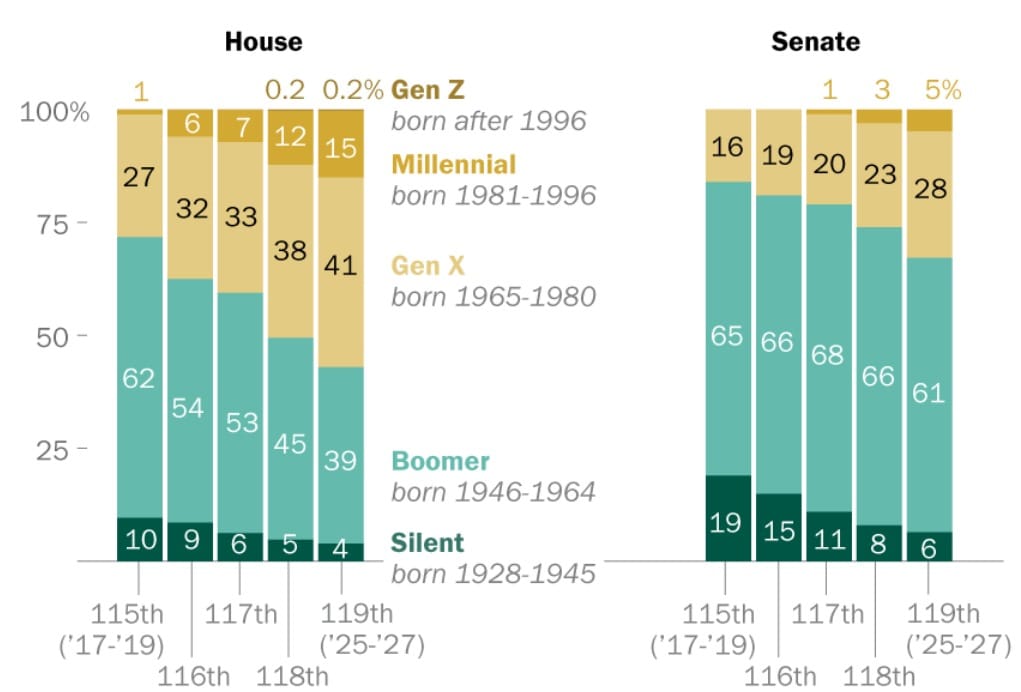
Pew Research graph on age trends in Congress.

The Senate is a different story. The majority held by Boomers may be shrinking, but they still hold 61% of the seats in the upper chamber.

However, while Congress may look different, the hyper-polarized environment between the Republican and Democratic Parties remains. In fact, worsening polarization has played a significant role in the changes seen in Congress.

During the 118th session, approximately 60 members announced they would not seek re-election, which is an unprecedentedly high number for a single congressional session – especially since most members are all but guaranteed reelection.

Since approximately 90% of US House districts are safe for the majority party in that district, the current system ensures protection for nearly all incumbents. So why have so many members chosen to quit all of a sudden?

There are a number of factors at play, but one of the biggest reasons is the increasing partisan divide.It doesn't matter what party has control of Congress. The divide between them is so wide that words like "compromise" and "cooperation" can lose someone their seat.

This has left the Legislative Branch in a state of perpetual gridlock on issues that matter to voters.

Former Republican US Rep Ken Buck criticized his own party for being "obsessively fixated on retribution and vengeance for contrived injustices of the past" when he announced his resignation in November 2023.

Democratic US Rep. Mike Quigley hasn't left Congress, but in 2023 he warned that continued gridlock "isn’t just an inconvenience; it leaves our nation vulnerable. It shows the world – allies and enemies – that we can’t govern."

And while the many resignations voters have seen over the last few years have allowed new candidates to emerge, things continue to get worse -- because the incentive to scorn the "other side" remains.

Many of the people elected to replace retiring or resigning members of Congress are elected under the same partisan primary system, where their biggest hurdle to election is winning a low-turnout party primary.

If they can secure a win in the primary, they essentially win the election outright. There are only a handful of cases where members of Congress have to face serious and real competition in a general election.

Congress may look more diverse. It may look a little younger. But nothing is going to change as long as the incentive is for members to cater solely to their party's base and party leaders who could threaten their seat with a primary challenge.

Adhere to the IVN etiquette

By posting a comment, you agree to adhere to our etiquette rules: No partisan attacks, no personal attacks, substantiate your sources, no self-promotion.

Get IVN’s Free Weekly Newsletter:Get IVN’s Free Newsletter

Get IVN’s Free Weekly Newsletter:Get IVN’s Free Newsletter

Nonpartisan Issues. Diverse Perspectives.

Check your inbox and click the link to confirm.

Republish this article

Republishing guidelines

Republish IVN articles for free. Independent Voter News articles may be republished online or in print under a Creative Commons BY-NC-ND 4.0 license, on these terms:

  1. Credit the author and IVN. Keep the byline ("By Author Name, Independent Voter News") and the attribution note at the end, which links to the original.
  2. Keep the meaning. You may update time and place references and apply your house style. You may trim for length, as long as the cuts don't change the meaning or misrepresent the author. Keep the headline. Mark any additions as your own (for example "Additional reporting by ...").
  3. Translations are welcome. Translate faithfully, add "Translated from English by [your outlet]", and tell us at editor@ivn.us.
  4. Keep the links, including the link to the original article.
  5. Keep the tracking image. The HTML includes a 1-pixel image that counts readers on your page. It collects no personal information.
  6. Photos and illustrations. Images credited to IVN may be used with this article only. Images credited to others (AP, Getty, Unsplash, Wikimedia and so on) stay under their owners' terms. Secure the rights or switch "Include images" off.
  7. Don't sell it. You can't sell our articles or sell ads specifically against them. Your normal site advertising is fine.
  8. No implied endorsement. Don't suggest that IVN or the author endorses you, your candidates or your causes, or that donations to you support IVN.
  9. Keep labels. Opinion or analysis pieces keep that label.
  10. Point search engines to the original. Set the canonical URL of your copy to the original IVN article (the HTML we give you includes the tag).
  11. No bulk or automated republishing, and don't submit our articles to aggregators (Apple News, Google News, MSN) as your own.
  12. Corrections and removals. Update your copy when we correct it, and remove it promptly if we ask. We'll contact you at the email you give us.
  13. Questions or print republication: editor@ivn.us.

IVN staff: fill in who you're inviting above, then create the invite.

Preparing the article

Research Shows Congress Is Getting Younger, But No Less Divided

Choose a format
  • HTML
  • Email HTML
  • Markdown
  • Formatted (.docx)
  • Plain text
  • WordPress blocks
  • PDF
Choose a platform

Photos credited to others need their owners' permission.

To for

Republishing somewhere else? Questions? editor@ivn.us