
Credit: sandi.net
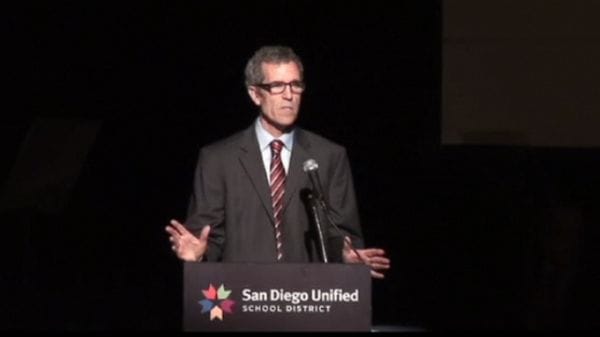
On October 2nd, San Diego Unified School District (SDUSD) Board President Dr. John Lee Evans gave his State of the District Address. Despite the talk of budget cuts, Dr. Evans gave a positive perspective with the progress schools have made. He noted what his Vision 2020 plan has done, how the district is defining and creating quality schools, and the role San Diegans have in education.
He opened the address with the cost-saving agreement that the teacher's union and district came to just before the beginning of the school year. Around 1,500 teachers and staff members had layoffs rescinded for the 2012-2013 school year. Dr. Evans sat down with both sides over the summer and made concessions to keep teachers in the classroom.
In the address, Dr. Evans used Fay Elementary as an example for the effects of the agreement:
Fay Elementary would have had only one out of their 28 teachers returning. The school would have been filled with teachers who had to transfer in from other schools. Lost would be all of the knowledge and relationships developed by the dedicated teachers who had stood by their school.
This led into how Vision 2020, adopted in 2009, has affected San Diego Unified. The plan changes the way student success is measured within the district. It places emphasis on critical and creative thinking so student learning goes beyond standardized testing. By creating an outside-the-box approach to academics, test scores inherently improve. Dr. Evans says, "We have to focus on having our students prepared for the world whenever they finish. Graduating just for the sake of graduating is not going to cut it. It must be meaningful."
Dr. Evans went into the indicators of Vision 2020's impact. He pointed out that only 43 schools in San Diego Unified were above an Academic Performance Index (API) score of 800 four years ago. By 2011, 104 schools scored above 800 API. Critics of the score-improvement claims say that the increases do not reflect demographics who are behind. However, Dr. Evans' response is:
Four years ago we said that we wanted our high performing students to keep improving and that we wanted our low performing groups to improve even faster. That is exactly what has happened. Our Asian and Caucasian students have progressed and our African American and Hispanic students have progressed even faster.
Vision 2020 is ties back to keeping teachers in their classrooms and providing quality education. Dr. Evans went into detail about how the community-based reform relies on teachers, parents, and staff working together:
Professional learning communities allow teachers at each grade level to take the responsibility for the achievement for all of the students at that school. Teachers will not be isolated in the classroom without peer and supervisor input. We will not just collect data. We will constantly analyze student achievement data to guide and improve instruction.
For example, if a third-grade class is not doing well, all third-grade teachers will band together to help improve that particular class. Teachers would have increased support to improve under-performing classes.
He ended with a call to action for parents, teachers, voters, board members, public officials and business owners. He stated the responsibilities of each person in the success of students within the San Diego Unified School District.
You can watch the entire speech here.
What we should take away from the speech is that San Diego Unified is changing the way students learn. The impact of the long-term plan can be seen today, but the board faces challenges to keep up progress. The district will face about $50 million in budget cuts if Proposition 30 does not pass. The district has also identified around $7 billion in infrastructure needs. Proposition Z, a $2.8 billion bond measure, is also on the ballot this November intended for infrastructure repair and upgrades.
Dr. John Lee Evans' seat on the San Diego Unified school board is up for election this year. He's facing Mark Powell to represent sub-district A. While Mark Powell won the sub-district June primary by a slim margin, the entire district will vote in November.