Skip to content
Sign up free
News

Social Media Favors Obama Debate Performance, Contrary to Press

Social Media Favors Obama Debate Performance, Contrary to Press

By Jane Susskind

2-minute read

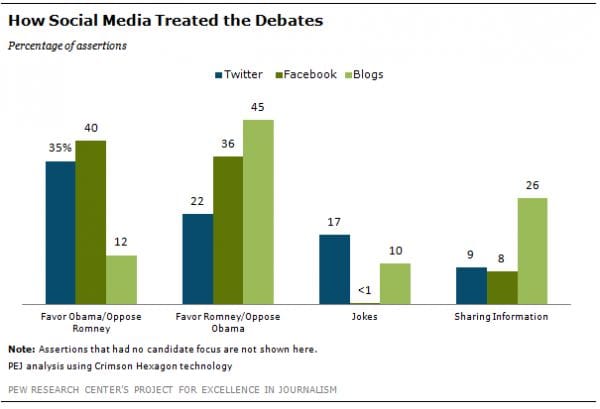
While Thursday morning's headlines echoed criticism towards Barack Obama's performance in the first presidential debate, tweets, status updates, and bloggers paint a different picture, with the majority of social discussions online favoring Obama over Mitt Romney. An analysis of the conversation surrounding Wednesday's presidential debate by Pew Research Center's Project for Excellence in Journalism shows that social media reacted more kindly towards Barack Obama than conventional media, with Twitter and Facebook conversations critical of Mitt Romney. Essentially, Pew's report highlights that social media favors Obama.
social media favors Obama

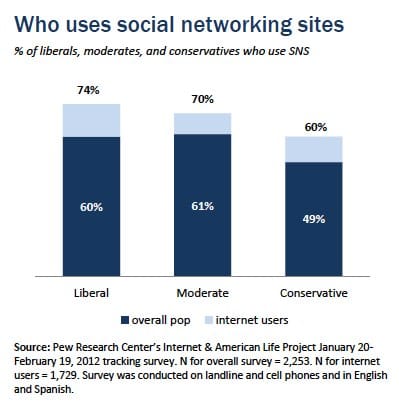
While this may have something to do with the nature of social media and it's ability to provide commentary in real-time, it also speaks to the demographic of users on social media. A recent Pew Internet survey breaks down social network users by political affiliation, finding that "the internet users who describe their political ideology as moderate or liberal are more likely than conservatives to use social networking sites." More specifically, 74% of internet users who describe their political attitudes as liberal and 70% who describe their attitudes as moderate use social media. Comparing this to the 60% of those identifying with Conservatism who are on social media, may provide an explanation for Wednesday's trend in positive sentiment and why social media favors Obama.
social media favors Obama

Pew notes that while conversation leaned towards Obama, it was not always in favor of his debate performance, rather a portion was criticizing his opponent.

"But those who favored Obama tweeted not so much to praise him as to criticize his opponent. Of the entire conversation, 9% praised the president and 26% was critical of Romney. Of those favoring Romney, 7% praised him and 15% criticized Obama."

Twitter users are primarily independent thinkers, with 22% identifying themselves as independent and 19% stating no political affiliation. The internet is, however, transforming into a new wave of journalism, with substantial implications on political reporting. Up 10% from 2008, 27.7% of likely voters get information about candidates and issues on the internet. In other words, over one quarter of voters turn to the internet to get election news, so sentiment from social media users reflects real world attitudes towards the presidential candidates.

Why do you think social media favors Obama? What role does it play in the 2012 election?

Tags: News

Adhere to the IVN etiquette

By posting a comment, you agree to adhere to our etiquette rules: No partisan attacks, no personal attacks, substantiate your sources, no self-promotion.

Get IVN’s Free Weekly Newsletter:Get IVN’s Free Newsletter

Get IVN’s Free Weekly Newsletter:Get IVN’s Free Newsletter

Nonpartisan Issues. Diverse Perspectives.

Check your inbox and click the link to confirm.

Republish this article

Republishing guidelines

Republish IVN articles for free. Independent Voter News articles may be republished online or in print under a Creative Commons BY-NC-ND 4.0 license, on these terms:

  1. Credit the author and IVN. Keep the byline ("By Author Name, Independent Voter News") and the attribution note at the end, which links to the original.
  2. Keep the meaning. You may update time and place references and apply your house style. You may trim for length, as long as the cuts don't change the meaning or misrepresent the author. Keep the headline. Mark any additions as your own (for example "Additional reporting by ...").
  3. Translations are welcome. Translate faithfully, add "Translated from English by [your outlet]", and tell us at editor@ivn.us.
  4. Keep the links, including the link to the original article.
  5. Keep the tracking image. The HTML includes a 1-pixel image that counts readers on your page. It collects no personal information.
  6. Photos and illustrations. Images credited to IVN may be used with this article only. Images credited to others (AP, Getty, Unsplash, Wikimedia and so on) stay under their owners' terms. Secure the rights or switch "Include images" off.
  7. Don't sell it. You can't sell our articles or sell ads specifically against them. Your normal site advertising is fine.
  8. No implied endorsement. Don't suggest that IVN or the author endorses you, your candidates or your causes, or that donations to you support IVN.
  9. Keep labels. Opinion or analysis pieces keep that label.
  10. Point search engines to the original. Set the canonical URL of your copy to the original IVN article (the HTML we give you includes the tag).
  11. No bulk or automated republishing, and don't submit our articles to aggregators (Apple News, Google News, MSN) as your own.
  12. Corrections and removals. Update your copy when we correct it, and remove it promptly if we ask. We'll contact you at the email you give us.
  13. Questions or print republication: editor@ivn.us.

IVN staff: fill in who you're inviting above, then create the invite.

Preparing the article

Social Media Favors Obama Debate Performance, Contrary to Press

Choose a format
  • HTML
  • Email HTML
  • Markdown
  • Formatted (.docx)
  • Plain text
  • WordPress blocks
  • PDF
Choose a platform

Photos credited to others need their owners' permission.

To for

Republishing somewhere else? Questions? editor@ivn.us