Skip to content
Sign up free
News

Social Slipups: 83 Million "Fake" Facebook Accounts

Social Slipups: 83 Million "Fake" Facebook Accounts

By Amanda Le

2-minute read

From facebookcraze.com
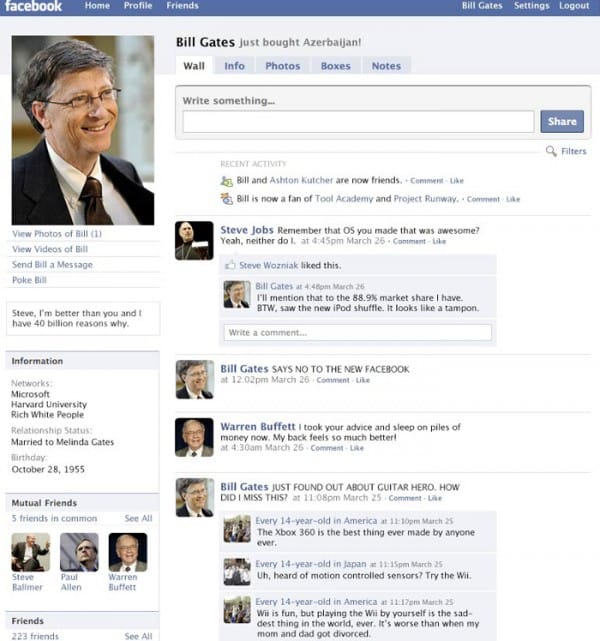
With a focus on social media blunders, Twitter gaffes, and Facebook faux pas, we’ll be profiling one politician, political figure, organization, or candidate who has committed one of the social media sins in our weekly series Social Slipups.

There is no question of the importance and growing impact social media has had, especially considering the huge role social networking has taken within people’s everyday life. Nowadays you’ll be hard pressed to find someone who doesn’t have a Facebook. One out of eight people on Earth are on Facebook according to research presented by brandignity.com and the company has gained almost a billion users on the social network site. But with great power comes great responsibility, which is exemplified in the company’s recent attempt to crack down on fake Facebook accounts.

The sin:

Facebook recently filed with the U.S. Securities and Exchange Commission in April that approximately 8.7 percent of their accounts are “fake”, adding up to a huge number of 83 million fraudulent users. According to the released data on fake accounts on Facebook, here are some stats. And just in case you were at the edge of your seat wondering exactly what kind of fake accounts are out there, there are three:

  1. “Duplicates”: Accounting for the majority of fake accounts, users who have more than one account under the same name are about 4.8 percent (45.8 million) of all Facebook accounts.
  2. “User-misclassified”: Are you a user managing your favorite cat or toaster’s Facebook account? Well then you are part of the 2.4 percent (22.9 million) of users on the site. But not all Facebook accounts under this category are purely for amusement. There is the argument that the only way users faced with endangerment through oppressive governments can feel safe is through creating an account through a psuedonym.
  3. And last but not least, we have the “Undesirable”: 1.5 percent (14.3 million) of Facebook’s active accounts were made with malicious intent of “trolling”, spamming, or spreading malware. Undoubtedly the group that should be concentrated on for its effect it can have on Facebook’s ad sector.

Although yes, social media and networking has transformed the world of technology with new ways of accessibility and communication there are also pitfalls associated with the very "open-ness" it prides itself on. The presence of fake accounts on Facebook is just an example of this and therefore this week’s “Social Slipup”.

Tags: News

Adhere to the IVN etiquette

By posting a comment, you agree to adhere to our etiquette rules: No partisan attacks, no personal attacks, substantiate your sources, no self-promotion.

Get IVN’s Free Weekly Newsletter:Get IVN’s Free Newsletter

Get IVN’s Free Weekly Newsletter:Get IVN’s Free Newsletter

Nonpartisan Issues. Diverse Perspectives.

Check your inbox and click the link to confirm.

Republish this article

Republishing guidelines

Republish IVN articles for free. Independent Voter News articles may be republished online or in print under a Creative Commons BY-NC-ND 4.0 license, on these terms:

  1. Credit the author and IVN. Keep the byline ("By Author Name, Independent Voter News") and the attribution note at the end, which links to the original.
  2. Keep the meaning. You may update time and place references and apply your house style. You may trim for length, as long as the cuts don't change the meaning or misrepresent the author. Keep the headline. Mark any additions as your own (for example "Additional reporting by ...").
  3. Translations are welcome. Translate faithfully, add "Translated from English by [your outlet]", and tell us at editor@ivn.us.
  4. Keep the links, including the link to the original article.
  5. Keep the tracking image. The HTML includes a 1-pixel image that counts readers on your page. It collects no personal information.
  6. Photos and illustrations. Images credited to IVN may be used with this article only. Images credited to others (AP, Getty, Unsplash, Wikimedia and so on) stay under their owners' terms. Secure the rights or switch "Include images" off.
  7. Don't sell it. You can't sell our articles or sell ads specifically against them. Your normal site advertising is fine.
  8. No implied endorsement. Don't suggest that IVN or the author endorses you, your candidates or your causes, or that donations to you support IVN.
  9. Keep labels. Opinion or analysis pieces keep that label.
  10. Point search engines to the original. Set the canonical URL of your copy to the original IVN article (the HTML we give you includes the tag).
  11. No bulk or automated republishing, and don't submit our articles to aggregators (Apple News, Google News, MSN) as your own.
  12. Corrections and removals. Update your copy when we correct it, and remove it promptly if we ask. We'll contact you at the email you give us.
  13. Questions or print republication: editor@ivn.us.

IVN staff: fill in who you're inviting above, then create the invite.

Preparing the article

Social Slipups: 83 Million "Fake" Facebook Accounts

Choose a format
  • HTML
  • Email HTML
  • Markdown
  • Formatted (.docx)
  • Plain text
  • WordPress blocks
  • PDF
Choose a platform

Photos credited to others need their owners' permission.

To for

Republishing somewhere else? Questions? editor@ivn.us