
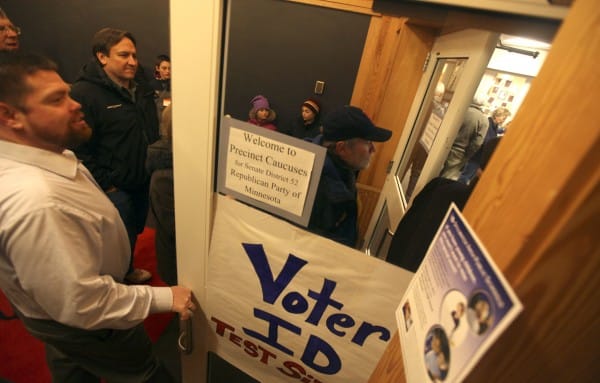
Voters in Minnesota line up in July to vote in primary elections and on a ballot referendum instituting a voter ID state constitutional amendment. Credit: blog.heritage.org
Recently, talks of voter fraud emerged from the political spectrum. Supplementing the rhetoric, a few studies regarding the issue attempted to set the matter straight. Comprehensive studies done by NYU's Brennan Center of Justice and News21 found that voter fraud rarely occurs for a multitude of reasons.
News21 investigated 2,068 cases of alleged fraud and found that "while fraud has occurred, the rate is infinitesimal, and in-person voter impersonation on Election Day, which prompted 37 state legislatures to enact or consider tough voter ID laws, is virtually non-existent." In addition, they have a frequently updated database that shows all of the cases of fraud and the status of each case. NYU's own study (conducted in 2007) found that "allegations of widespread voter fraud, however, often prove greatly exaggerated."
News21's data agrees with this notion, as "analysis of the resulting comprehensive News21 election fraud database turned up 10 cases of voter impersonation. With 146 million registered voters in the United States during that time, those 10 cases represent one out of about every 15 million prospective voters." In fairness, News21 readily admits that not every case can be counted, as some do successfully cheat the system. Still, it does not seem unreasonable to believe given this data that the amount of people committing successful fraud has any real impact on elections.
Justin Levitt, the author of the NYU study, explains why most people simply do not wish to commit fraud. For one, the punishment remains harsh. A $10,000 fine, five years in prison, state penalties, and possibly deportation can easily deter one from committing fraud, especially when the yield remains a few extra votes at best. Aside from the punishment, going about committing fraud can become difficult and tedious. Getting entered into the database under multiple personas is not as easy as it may initially seem, especially when considering the possible need (depending on the state) for multiple ID's, addresses, citizenships, or other personal records.
To further deconstruct the argument, many of the alleged cases of voter fraud occur because of simple human error, especially typos. Errors in poll books, election official counting errors, bad matching, errors in registration records, death record errors, moving errors, and so on all contribute to these alleged cases of voter fraud. Fraud implies intent, and clearly mistakes remain unintentional, although one might target the system for allowing these mistakes in the first place.
Clearly, the data does not paint a picture perfect snapshot of voter fraud, but it gives a very good sense of its severity. Another popular study done by the Republican National Lawyers Association (RNLA) examined cases that occurred throughout the states. In total, they identified roughly 311 cases since 2000. While this study gets cited a great amount in arguments against voter ID, one should note that their claims have been taken out of context.
In their own words, their study illustrates "a comprehensive list of all instances of vote fraud. The RNLA conducted a limited survey to indicate whether vote fraud charges have been filed in states across the country since 2000. We looked for at least one example in each state." Their blog even keeps notes on cases of voter fraud.
In short, the data vividly depicts the rarity of voter fraud in the United States. Whether or not that justifies preventing voting ID laws from passing remains another issue.