Skip to content
Sign up free
News

Synthetic Genomics CEO Announces Bleak Outlook for Biofuels

Synthetic Genomics CEO Announces Bleak Outlook for Biofuels

By Cassidy Noblejas Bartolomei

2-minute read

Credit: Synthetic Genomics, Inc.
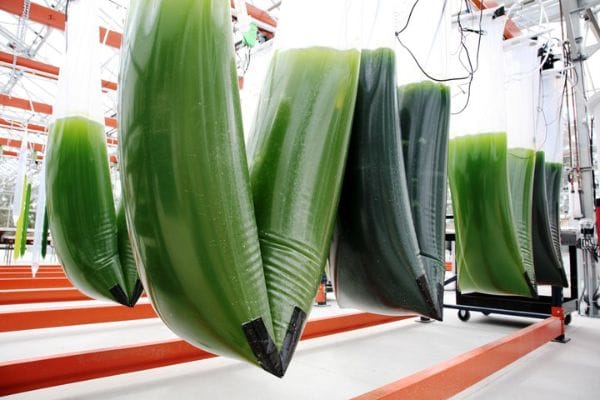
Algae growing in closed bioreactors in SGI/Exxon Mobil greenhouse

John Craig Venter, CEO of Synthetic Genomics announced earlier this month, consumers must continue to wait for an alternative energy source to fossil fuels until the federal government establishes an effective carbon policy.

Since Synthetic Genomics opened on Torrey Pines Road in La Jolla in 2005, it has been pioneering genomic science to unlock the potential of microbial and plant resources to develop products that address global energy and environmental challenges. Synthetic Genomics teamed with the J. Craig Venter Institute (JCVI) to commercialize its genomic-driven technologies.

The company has successfully commercialized a one-step isothermal approach to enable rapid assembly of DNA fragments called the Gibson Assembly, but has been unable to progress commercially in its most sought after product areas; namely, renewable fuels and chemicals.

Synthetic Genomics partnered with ExxonMobil in 2009 for a multi-year research and development strategic alliance to focus on exploring the most efficient and cost effective ways to produce biofuels using photosynthetic algae. The algae, capable of producing fuel and chemicals directly from sunlight and carbon dioxide, is being designed to streamline with the market’s existing distribution infrastructure.

Despite the JCVI’s cutting edge scientific research and Synthetic Genomics' unique business model, the effort to provide next generation biofuels has proved difficult. At a presentation on genomics and synthetic biology in San Diego, Venter declared, “It doesn’t matter what the scientific breakthroughs are, there’s no way to beat oil… Basically, if we don’t have a carbon policy, and an effective carbon policy soon, biofuels are just dead.”

Venter explained the present federal regulations make is impossible for fuel made out of renewables to compete with the production of oil companies, but the Synthetic Genomics partnership with Exxon will continue its efforts.

The steep increases in gas prices, declining health of the environment, and the erosion of the world economy demands that petroleum production be curtailed or improved; but the demands of the work-a-day world have made such reductions impossible and improvements difficult. Consumers have been teased time and time again with the promise of alternative fuel sources, and for the time being, synthetically engineered biofuels have proved to be yet another tease.

Tags: News

Adhere to the IVN etiquette

By posting a comment, you agree to adhere to our etiquette rules: No partisan attacks, no personal attacks, substantiate your sources, no self-promotion.

Get IVN’s Free Weekly Newsletter:Get IVN’s Free Newsletter

Get IVN’s Free Weekly Newsletter:Get IVN’s Free Newsletter

Nonpartisan Issues. Diverse Perspectives.

Check your inbox and click the link to confirm.

Republish this article

Republishing guidelines

Republish IVN articles for free. Independent Voter News articles may be republished online or in print under a Creative Commons BY-NC-ND 4.0 license, on these terms:

  1. Credit the author and IVN. Keep the byline ("By Author Name, Independent Voter News") and the attribution note at the end, which links to the original.
  2. Keep the meaning. You may update time and place references and apply your house style. You may trim for length, as long as the cuts don't change the meaning or misrepresent the author. Keep the headline. Mark any additions as your own (for example "Additional reporting by ...").
  3. Translations are welcome. Translate faithfully, add "Translated from English by [your outlet]", and tell us at editor@ivn.us.
  4. Keep the links, including the link to the original article.
  5. Keep the tracking image. The HTML includes a 1-pixel image that counts readers on your page. It collects no personal information.
  6. Photos and illustrations. Images credited to IVN may be used with this article only. Images credited to others (AP, Getty, Unsplash, Wikimedia and so on) stay under their owners' terms. Secure the rights or switch "Include images" off.
  7. Don't sell it. You can't sell our articles or sell ads specifically against them. Your normal site advertising is fine.
  8. No implied endorsement. Don't suggest that IVN or the author endorses you, your candidates or your causes, or that donations to you support IVN.
  9. Keep labels. Opinion or analysis pieces keep that label.
  10. Point search engines to the original. Set the canonical URL of your copy to the original IVN article (the HTML we give you includes the tag).
  11. No bulk or automated republishing, and don't submit our articles to aggregators (Apple News, Google News, MSN) as your own.
  12. Corrections and removals. Update your copy when we correct it, and remove it promptly if we ask. We'll contact you at the email you give us.
  13. Questions or print republication: editor@ivn.us.

IVN staff: fill in who you're inviting above, then create the invite.

Preparing the article

Synthetic Genomics CEO Announces Bleak Outlook for Biofuels

Choose a format
  • HTML
  • Email HTML
  • Markdown
  • Formatted (.docx)
  • Plain text
  • WordPress blocks
  • PDF
Choose a platform

Photos credited to others need their owners' permission.

To for

Republishing somewhere else? Questions? editor@ivn.us