Skip to content
Sign up free
News

Taxpayers Continue to Flee States with Heaviest Tax Burdens

Taxpayers Continue to Flee States with Heaviest Tax Burdens

By State Data Lab

2-minute read

United Van Lines (UVL) is one of the largest moving companies in the United States. Each year since 1977, UVL has issued a study of interstate migration patterns. This study reports the share of outbound shipments in total interstate shipments for UVL for each of the 48 “Lower United States” (e.g. all states but Alaska and Hawaii). We include this data in State Data Lab, along with a wide variety of other economic, demographic, and government financial data.

On January 2 2014, UVL publicly released the results of its latest (2013) migration study. The results were generally in line with those in 2012, and states with greater fiscal challenges continue to experience greater out-migration.

Here’s a list of the eight states for which UVL reported the highest share of inbound shipments in total shipments (e.g. higher net in-migration):

  1. Oregon
  2. South Carolina
  3. North Carolina
  4. South Dakota
  5. Nevada
  6. Texas
  7. Colorado
  8. Florida

At the other end of the spectrum, here are the ten states with the highest share of outbound shipments (e.g. greater net out-migration) in total UVL shipments in 2013:

  1. New Jersey
  2. Illinois
  3. New York
  4. West Virginia
  5. Connecticut
  6. Utah
  7. Kentucky
  8. Massachusetts
  9. New Mexico
  10. Mississippi

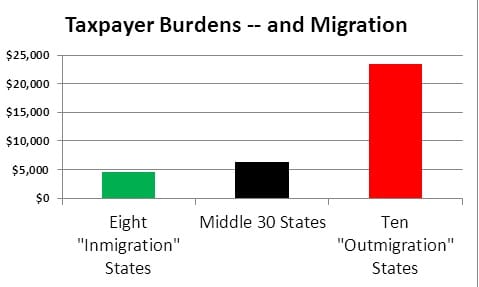
Most of the state governments for these top 10 ‘exit’ states are facing significantly greater fiscal challenges than other states. The chart below shows the average Truth in Accounting estimate for “Taxpayer Burden” (a measure of state debt loads in light of assets available to pay bills). Three categories are shown: the 8 states with high in-migration, the 10 states with high out-migration, and the other 30 continental states. States in the ‘top 10’ for out-migration clearly have the worst fiscal challenges. Credit: Truth in Accounting
Credit: Truth in Accounting

Recent out-migration patterns have weighed on the financial performance of the fiscally challenged states, mainly through the implications for tax revenue.  However, the TIA “Taxpayer Burden” estimate is a product of long-running fiscal practices, not just recent migration trends. In especially fiscally-challenged states, the factors driving poor long-run fiscal outcomes have also been making moves into the state less attractive, while prompting some residents (and their income) to seek out higher / drier ground.In November 2013, the American Legislative Exchange Council (ALEC) issued their annual “State Tax Cut Round Up.” This survey looks across a broad range of tax categories and also produces a bottom-line estimate for the number of states that “cut taxes.” ALEC determined that 18 states effectively “cut taxes” in 2013.

When ranking the lower 48 states on the TIA “Taxpayer Burden” estimate, none of the 10 states with the highest Taxpayer Burdens “cut taxes” in 2013. And, the average “outbound shipments %” for these fiscally challenged states came to 56% in 2013, well above the 48-state average.

Fiscally challenged states are challenged in part because some voters are voting with their feet. By choice or necessity, these states have also been less likely to respond with favorable tax changes.

Tags: News

Adhere to the IVN etiquette

By posting a comment, you agree to adhere to our etiquette rules: No partisan attacks, no personal attacks, substantiate your sources, no self-promotion.

Get IVN’s Free Weekly Newsletter:Get IVN’s Free Newsletter

Get IVN’s Free Weekly Newsletter:Get IVN’s Free Newsletter

Nonpartisan Issues. Diverse Perspectives.

Check your inbox and click the link to confirm.

Republish this article

Republishing guidelines

Republish IVN articles for free. Independent Voter News articles may be republished online or in print under a Creative Commons BY-NC-ND 4.0 license, on these terms:

  1. Credit the author and IVN. Keep the byline ("By Author Name, Independent Voter News") and the attribution note at the end, which links to the original.
  2. Keep the meaning. You may update time and place references and apply your house style. You may trim for length, as long as the cuts don't change the meaning or misrepresent the author. Keep the headline. Mark any additions as your own (for example "Additional reporting by ...").
  3. Translations are welcome. Translate faithfully, add "Translated from English by [your outlet]", and tell us at editor@ivn.us.
  4. Keep the links, including the link to the original article.
  5. Keep the tracking image. The HTML includes a 1-pixel image that counts readers on your page. It collects no personal information.
  6. Photos and illustrations. Images credited to IVN may be used with this article only. Images credited to others (AP, Getty, Unsplash, Wikimedia and so on) stay under their owners' terms. Secure the rights or switch "Include images" off.
  7. Don't sell it. You can't sell our articles or sell ads specifically against them. Your normal site advertising is fine.
  8. No implied endorsement. Don't suggest that IVN or the author endorses you, your candidates or your causes, or that donations to you support IVN.
  9. Keep labels. Opinion or analysis pieces keep that label.
  10. Point search engines to the original. Set the canonical URL of your copy to the original IVN article (the HTML we give you includes the tag).
  11. No bulk or automated republishing, and don't submit our articles to aggregators (Apple News, Google News, MSN) as your own.
  12. Corrections and removals. Update your copy when we correct it, and remove it promptly if we ask. We'll contact you at the email you give us.
  13. Questions or print republication: editor@ivn.us.

IVN staff: fill in who you're inviting above, then create the invite.

Preparing the article

Taxpayers Continue to Flee States with Heaviest Tax Burdens

Choose a format
  • HTML
  • Email HTML
  • Markdown
  • Formatted (.docx)
  • Plain text
  • WordPress blocks
  • PDF
Choose a platform

Photos credited to others need their owners' permission.

To for

Republishing somewhere else? Questions? editor@ivn.us