
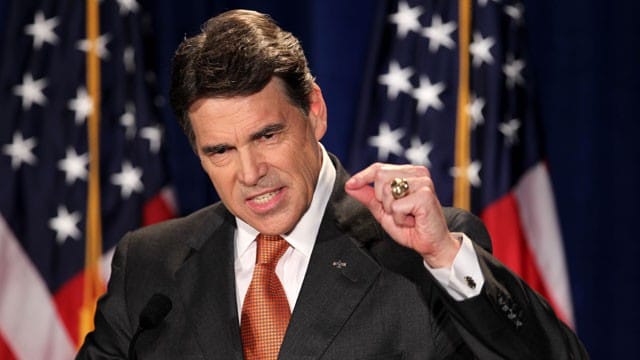
Governor Rick Perry of Texas joins a list of growing states who say they will refuse to implement Medicaid expansion in their states. The one-time presidential hopeful stated yesterday, “If anyone was in doubt, we in Texas have no intention to implement so-called state exchanges or to expand Medicaid under Obamacare.”
Gov. Rick Perry’s decision makes Texas the sixth state to opt out of Medicaid expansion so far. Texas joins Florida, Louisiana, Mississippi, South Carolina, and Wisconsin in using their Supreme Court-given right to say no to the funding.
The Supreme Court ruled to uphold most of Obama’s Affordable Care Act provisions, but struck down the part of the law requiring states to expand Medicaid eligibility.
Perry’s office sent a letter to U.S. Health and Human Services Secretary Kathlen Sebelius making his opposition to the Bill official. In turn, by opting out of Medicaid expansion, Perry chose on behalf of Texas not to accept “more than a hundred million federal dollars over the next several years to put more poor Texas adults onto Medicaid."
The Kaiser Family Foundation found that 1.4 million uninsured Texans would have received Medicaid coverage if Gov. Rick Perry had made the decision to participate in Medicaid expansion. This would cut the number of uninsured people in Texas by 49.4% by 2019.
Gov. Rick Perry said in his statement regarding his decision:
"… I will not be party to socializing healthcare and bankrupting my state in direct contradiction to our Constitution and our founding principles of limited government. I stand proudly with the growing chorus of governors who reject the Obamacare power grab. Neither a 'state' exchange nor the expansion of Medicaid under this program would result in better 'patient protection' or in more 'affordable care.' They would only make Texas a mere appendage of the federal government when it comes to health care."
According to the Congressional Budget Offices, “if all states went ahead with Medicaid expansion, it would increase state spending on the program by $73 billion by 2022 – the equivalent of a 2.8% increase in what states would have spent on Medicaid from 2014 to 2022 in the absence of health reform.”
Out of the six states that have already publicly opted out of Medicaid expansion, three of them have uninsured rates higher than the national average, which is 16%. Louisiana: 17% uninsured, South Carolina: 19% uninsured, and Florida: 21% uninsured.
If more governors continue to opt out, or threaten to opt out, of the Medicaid expansion, the poorest Americans will suffer most. According to charts from Washington Post’s Wonk Blog, “People who earn less than 100% of the Federal Poverty Line, which is approximately $11,170 per individual, are ineligible for tax credits to purchase health insurance.”
Wonk Blog also stated in another article referencing Medicaid expansion that not only poor Americans would suffer, but also poor, childless adults are most in danger.
“Childless adults tend to have even lower eligibility in state Medicaid programs. Forty-three states do not cover single adults at any level of the poverty line. If those states opt out of the Medicaid expansion, adults without children would find themselves in a sort of donut hole: Ineligible for Medicaid but also too poor to qualify for federal subsidies.”
The Urban Institute cited under the current system, “state and local governments help hospitals offset the cost of care they provide to uninsured patients who can’t pay for medical care — paying about $10.5 billion, or 18.5%, of the cost of uncompensated care.” Thus, if Medicaid covered more patients, those high costs that state and local governments offset, would decrease.
The six governors that have opted out of Medicaid expansion arguably did so for ideological reasons. There is no denying that expanding Medicaid may cost more for states upfront, but the long-term outcomes of doing so prove to actually save states more money in the future, increase state budgets, and avoid increasing rates of uninsured Americans.
Ten states and the District of Columbia have chosen to participate in the expansion, which includes California, Connecticut, Delaware, Hawaii, Illinois, Maryland, Massachusetts, Minnesota, Vermont, and Washington.
Ironically states that have already opted out of Medicaid expansion would have proven to be the highest beneficiaries. Kaiser Family Foundation concluded “the Medicaid expansion in the new law would cut South Carolina’s uninsured rate among eligible adults by 56.4%. This would be the fourth largest drop of any state in the nation.”