Skip to content
Sign up free
News

Fall of the Middle-Class: What a Difference Ten Years Makes

Fall of the Middle-Class: What a Difference Ten Years Makes

By Brandon Fallon

2-minute read

The greatest casualty of this slowly recovering economy has been the fall of the middle-class, but the decline did not begin in 2007 or 2008. The past decade has been the most financially unstable for the middle-income tier since World War II. At least that is the take-away from a recent Pew Research Center study about household income and net worth. The election is 75 days away, but President Obama had set up a Middle-Class Task Force since February 27, 2009 to tackle the issues that plague the majority of Americans. They began with green jobs and tax cuts, but the gridlock between the administration and Congress has led to less than expected results. As a result, just over half (52%) of middle-class voters feel that the President's policies will help over the next four years. That still is better compared to the 42% of self-perceived middle-class voters feel about Gov. Romney's policies.

In terms of how Obama's and Romney's policies are perceived as benefiting the upper-class, the Pew Research Center's report shows the opposite. Romney gets the edge in this category, where the respondents perceive the Republican candidate's policies benefiting the President's 71% to 38%, respectively. This plays into Chicago's message that Romney favors the millionaires and billionaires over the majority of Americans.

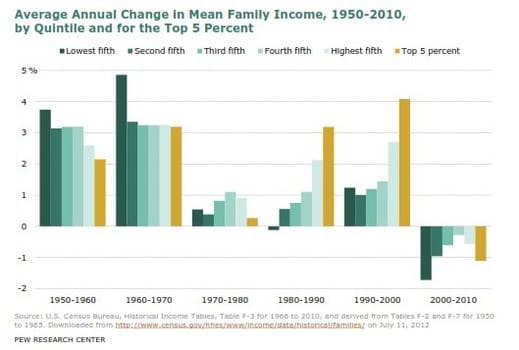
Fully 85% of Americans who describe themselves as middle class say it is more difficult now than it was a decade ago for middle-class people to maintain their standard of living. This downbeat take comes at the end of a decade in which mean family incomes declined for Americans overall for the first time since the end of World War II.

The decrease in middle-class confidence also coincided with the upper income tier taking a substantially larger slice of the nation's household income pie. While the middle-class lost 17% since 1970, the upper-class gained 17 points in household income, from 29% to 46%, juxtaposed with the, middle-class' decline from 62% to 45%.

But only the upper tier has increased its share of the nation's total household income. In 2010, the upper tier took in 46% of the nation's household income, up from 29% in 1970. In 2010, the upper tier took in 46% of the nation's household income, up from 29% in 1970. The middle tier took in 45%, down from 62%.

Even though the research was conducted prior to Gov. Romney selecting Rep. Paul Ryan as his running mate, that pick does not change how the survey respondent's felt over the past several years. Even though the past decade can be seen as a decline for the middle-class, in general it may not feel like the rise of any other class. The global recession made sure of that and the next president, whoever it will be, will have to find a way to help more than just the middle-class.

Tags: News

Adhere to the IVN etiquette

By posting a comment, you agree to adhere to our etiquette rules: No partisan attacks, no personal attacks, substantiate your sources, no self-promotion.

Get IVN’s Free Weekly Newsletter:Get IVN’s Free Newsletter

Get IVN’s Free Weekly Newsletter:Get IVN’s Free Newsletter

Nonpartisan Issues. Diverse Perspectives.

Check your inbox and click the link to confirm.

Republish this article

Republishing guidelines

Republish IVN articles for free. Independent Voter News articles may be republished online or in print under a Creative Commons BY-NC-ND 4.0 license, on these terms:

  1. Credit the author and IVN. Keep the byline ("By Author Name, Independent Voter News") and the attribution note at the end, which links to the original.
  2. Keep the meaning. You may update time and place references and apply your house style. You may trim for length, as long as the cuts don't change the meaning or misrepresent the author. Keep the headline. Mark any additions as your own (for example "Additional reporting by ...").
  3. Translations are welcome. Translate faithfully, add "Translated from English by [your outlet]", and tell us at editor@ivn.us.
  4. Keep the links, including the link to the original article.
  5. Keep the tracking image. The HTML includes a 1-pixel image that counts readers on your page. It collects no personal information.
  6. Photos and illustrations. Images credited to IVN may be used with this article only. Images credited to others (AP, Getty, Unsplash, Wikimedia and so on) stay under their owners' terms. Secure the rights or switch "Include images" off.
  7. Don't sell it. You can't sell our articles or sell ads specifically against them. Your normal site advertising is fine.
  8. No implied endorsement. Don't suggest that IVN or the author endorses you, your candidates or your causes, or that donations to you support IVN.
  9. Keep labels. Opinion or analysis pieces keep that label.
  10. Point search engines to the original. Set the canonical URL of your copy to the original IVN article (the HTML we give you includes the tag).
  11. No bulk or automated republishing, and don't submit our articles to aggregators (Apple News, Google News, MSN) as your own.
  12. Corrections and removals. Update your copy when we correct it, and remove it promptly if we ask. We'll contact you at the email you give us.
  13. Questions or print republication: editor@ivn.us.

IVN staff: fill in who you're inviting above, then create the invite.

Preparing the article

Fall of the Middle-Class: What a Difference Ten Years Makes

Choose a format
  • HTML
  • Email HTML
  • Markdown
  • Formatted (.docx)
  • Plain text
  • WordPress blocks
  • PDF
Choose a platform

Photos credited to others need their owners' permission.

To for

Republishing somewhere else? Questions? editor@ivn.us