
Participation in the electoral process is the cornerstone of democracy, and according to a recent study led by the University of California, San Diego, increased voter participation could be more accessible than we recently thought. Voter education and "get out the vote" campaigns have struggled to appeal to voters nationwide, and while efforts result in an increase in voter participation, costs of traditional campaigning limit the reach of such campaigns.
What if the most effective way to increase voter turnout was also the easiest?
The UCSD study suggests that the social sharing aspect of Facebook may be responsible for a major boost in voter turnout in 2010.
“Our study suggests that social influence may be the best way to increase voter turnout. Just as importantly, we show that what happens online matters a lot for the ‘real world,’” said UC San Diego professor and lead author to the study.
The Study
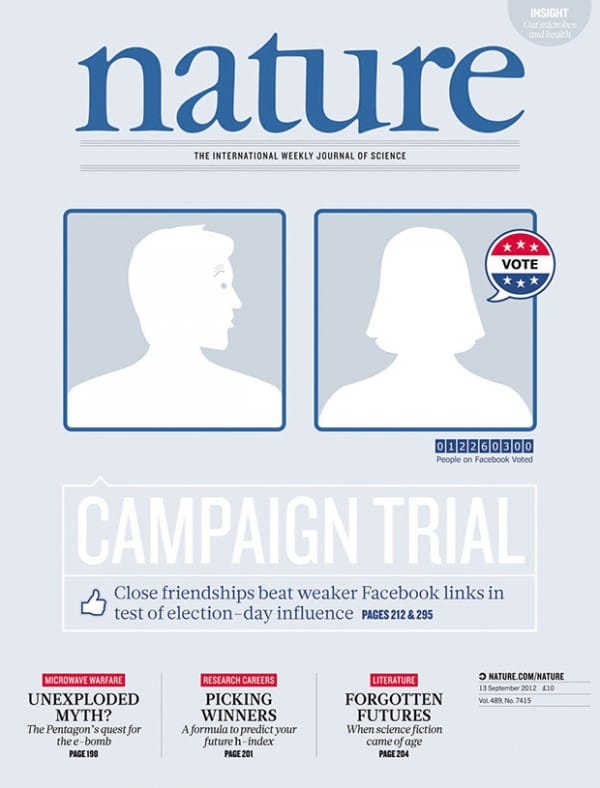
In this 61-million-person experiment, Facebook users were presented with a "social, non-partisan 'get out the vote' nessage at the top of their news feeds on Nov. 2, 2012." The message reminded users to vote and featured an "I Voted" button, reporting how many people on Facebook had voted, including photos of up to six Facebook friends who had voted.
There were two control groups:
- 600,000 people saw a modified "informational message," identical in all aspects except for pictures of friends
- 600,000 people saw no message on Election Day
Of the three groups, those who saw images of their friends were more likely to vote, in what Fowler attributes to peer pressure.
Users who got the informational message – who didn’t see photos of friends – voted at the same rates as those who saw no message at all. Those who saw photos of friends, on the other hand, were indeed more likely to vote.
Friends Don't Let Friends Not Vote
Identified in the UC San Diego summary as "The Friend Factor," Fowler notes that political mobilization can be attributed to social influence.
“It’s not the ‘I Voted’ button, or the lapel sticker we’ve all seen, that gets out the vote. It’s the person attached to it.”
Peer pressure on Facebook resulted in an additional 60,000 votes in 2010, prompting users who saw the Facebook social message to get out and vote. When compared to those who saw no message, friends of social-messaging recipients were more likely to vote.
What's more, closer friends matter most. Assuming that closer friends interact with each other more on Facebook, those who saw their closer friends voting on Facebook were more likely to follow suit. According to Fowler, "it was these close relationships that accounted for virtually all the difference in voting." While the study did not focus on partisanship, the study found no evidence that party affiliation of one's Facebook friends had any influence on the tendency to vote.
Variables to Consider
Fowler and colleagues took into account the tendency of Facebook users to say they voted on Facebook but not actually participate in the electoral process. Using publicly available voting records, the team was able to estimate that around 4 percent of those who said they had voted hadn't, which were excluded from the conclusions of the study.
It is also important to note that voter turnout increases during a presidential primary, as confirmed by the U.S. Census Bureau. In 2008, when Americans were not only voting for state and local initiatives, but were also voting for presidential nominees in a heated Democratic primary, voter turnout was about 53%. In 2010, however, voter participation dropped to 37%, showing the glaring deficit in civic engagement during non-presidential primaries.
What are your thoughts? Does Facebook influence your decision to vote?