
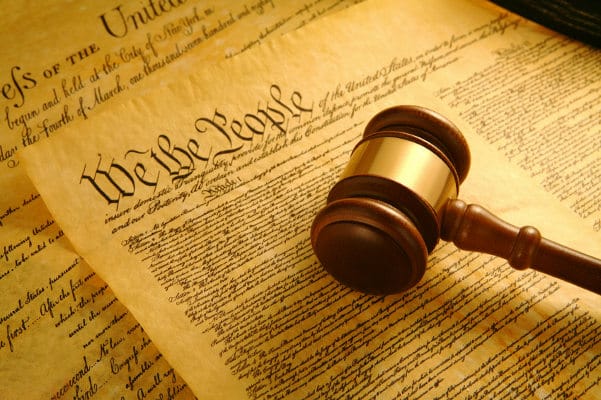
Yesterday was July 4th, that fateful day in 1776 when John Hancock stepped forward to be the first to sign the Declaration of Independence, and oddly enough, it induces many to sing the praises of what came afterwards, the US Constitution. Odd, because the Declaration remains, along with the much longer Communist Manifesto, a compelling expression of the irrepressible human desire for liberty, while the US Constitution created the legal foundations of a liberal nation-state that would ensure that these desires remained safely contained.
Drafted by property-owning white males to suppress the lumpen rebelliousness of those involved in the Shays' Rebellion, it has been so effective that many nations around the world have adopted their own versions. Even the most notorious dictators and oligarchies have accepted the need to legitimize their rule by reference to a sacred text of national rights and privileges.
As recognized by Charles Beard, the primary purpose of those who attended the Constitutional Convention was economic, the preservation of their economic power over others, couched in the language of individual liberty. Hence, the centerpiece was the protection of private property rights, which included, of course, the right to own slaves and trade them like sugar, tobacco and textiles. In order to protect this nascent, vulnerable new social order, the delegates left it to the states to establish voting rights, which were, until the advent of Andrew Jackson, limited to propertied white males.
African Americans weren't granted the franchise until after the Civil War, while women did not obtain it until much later in the 20th Century. Even then, in the cases of poor people and people of color, poll taxes and literacy tests sharply reduced their actual electoral participation until the 1960s. There was, in effect, a general relationship between expanding voting rights throughout the populace as elites recognized such expansions would not threaten American capitalism.
Of course, the most important institutional protections of private property remain: the Senate and the Supreme Court. The Senate, an institution conceived by the delegates to create a virtual House of Lords, whereby the wealthiest, most powerful figures in society could block measures deemed too radical and shape them to their advantage. As demonstrated by the passage of the Affordable Care Act, it still serves this function even as its members are now elected by the populace instead of state legislatures. Similarly, the Supreme Court serves as a backstop to catch anything that might get past the Senate and the President, as it did during the New Deal. Only the prospect of social unrest persuaded the Court to back down and allow many of FDR's measures to take effect.
Admittedly, the protection of property rights has had the ancillary benefit of firmly establishing some civil liberties. While initially weighted in favor of those with enough money to buy a printing press, the First Amendment has provided opportunities for speech and protest that were absent elsewhere. Other amendments, the Fourth and the Sixth, granted procedural rights to people accused of crimes, the prohibition against unreasonable searches and seizure, the right to receive notice of the charges, the right against self-incrimination, the right to a defense and the right to a jury trial. Such rights stand the test of time into the present day, one need only look at the prosecutions during anti-terror campaigns in Italy in the 1970s and Peru in the 1990s to recognize that they are yet to be universally accepted.
But not everyone has been able to avail themselves of these protections. African Americans are, of course, the most obvious example, subjected to lynchings and frame ups for decades as Southern whites sought to entrap them within the South for continued exploitation, even obstructing their right to travel to Northern factories for employment outside the sharecropping system. FDR interned Japanese Americans during World War II, an administrative action upheld by the Supreme Court in a decision that remains good law for possible future use against Arab and Persian Americans in the event of intensified conflict in the Middle East. Numerous other examples include the efforts to suppress abolitionists, Mormons, Copperheads, Wobblies, union activists, and the radical movements of the 1960s.
The Palmer raids against leftists in 1919, many of them immigrants, and the COINTELPRO program of the 1960s were particularly egregious instances of the acceptable suspension of constitutional rights when necessary to defend American capitalism. Mark Clark, shot dead in his bed by the Chicago Police Department in 1969, serves as a classic instance of such a suspension. I have no doubt that we will see the reemergence of similar practices if social unrest reaches such levels of intensity in the future. We already see signs of it in the coordinated response to the Occupy protests.
For people elsewhere in the world, the US Constitution is meaningless, it provides them no protection against an aggressive superpower willing to kill, torture, and incarcerate people to attain its objectives. People seized and transported to detention centers in Guantanamo, Bagram, and Poland, among other places, for indefinite detention and torture have no means of challenging these actions. After the US Supreme Court granted limited procedural rights to Guantanamo detainees, the DC Circuit Court of Appeals has rendered them meaningless by reflexively upholding such detentions upon the presentation of any government justification.
In this, the court is utilizing a practice analogous to the domestic one of deference to prison officials in any dispute over conditions of confinement for inmates. Beyond this, the US launches drone strikes, airstrikes, and night raids in several countries in the Middle East and Africa, with the President making personal decisions to place people on a kill list. Many hill peoples in Pakistan and Afghanistan live in a state of perpetual fear, always scanning the sky for the presence of drones. Given that the President has decided that all military age males are "militants," it is impossible to know the extent to which these attacks kill people with no connection to armed resistance to the US. We can, however, say with confidence that they are directed against the some of the poorest people on earth, people who, perhaps not so coincidentally, persist in living beyond the control of nation states to the greatest extent possible.