Skip to content
Sign up free
News

Twitter Transparency: US Requests for User Information Up 33 Percent

Twitter Transparency: US Requests for User Information Up 33 Percent

By Jane Susskind

2-minute read

"Twitter is committed to the open exchange of information," reads the report website.
twitter_transparency

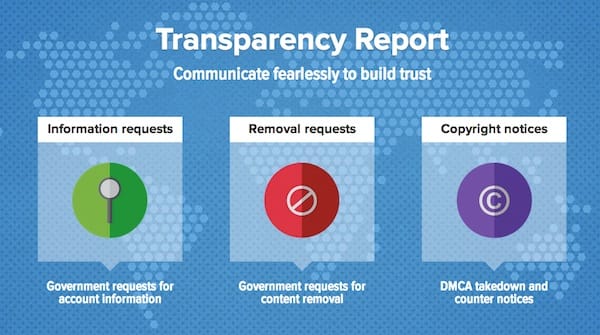
Twitter recently released its third biannual transparency report, sharing with the public the number of requests for information, removal requests, and copyright notices it has received from 26 different governments around the world.

The report also includes Twitter's response to these requests, providing insight into the percentage of cases the company responds to with partial or full information.

According to Twitter's data, the United States made 902 user information requests, the most of any country included in the report. In fact, requests coming from the United States comprised 78% of all requests, with Japan and the United Kingdom taking the number two and three spots, respectively.

Comparing these numbers to those of the company's first Twitter transparency report, published on July 2, 2012, it becomes apparent that the number of government requests has significantly increased.

Since its first publication, the number of requests for user information submitted to Twitter by the United States government has jumped from 679  to 902 - an increase of 33 percent.

While an increase of 223 requests total over the course of a year and half may seem minimal, "the concern is over the trend," says Chris Calabrese, a legislative counsel with the American Civil Liberties Union.

And this trend is not unique to the United States. Twitter has seen an overall increase in government requests, as made evident in the chart below:

Increased government requests, however, may not be an indication of increased government overreach, and rather can be explained by the novelty of the company. Twitter was launched in 2006, but saw exponential growth in 2012, partially due to its increased role in the 2012 election. The increase in requests could just be a response to the increase in usage, with over 200 million users actively on the site.

As government requests for information continue to grow, Twitter will face increased scrutiny, especially with the NSA scandal inducing heightened concern over the privacy of our data online. For the first half of 2013, Twitter produced some or all of the information for 67% of US government requests.

How the company chooses to respond in the second half of 2013 will be a key factor in the success and continued use of the network.

Tags: News

Adhere to the IVN etiquette

By posting a comment, you agree to adhere to our etiquette rules: No partisan attacks, no personal attacks, substantiate your sources, no self-promotion.

Get IVN’s Free Weekly Newsletter:Get IVN’s Free Newsletter

Get IVN’s Free Weekly Newsletter:Get IVN’s Free Newsletter

Nonpartisan Issues. Diverse Perspectives.

Check your inbox and click the link to confirm.

Republish this article

Republishing guidelines

Republish IVN articles for free. Independent Voter News articles may be republished online or in print under a Creative Commons BY-NC-ND 4.0 license, on these terms:

  1. Credit the author and IVN. Keep the byline ("By Author Name, Independent Voter News") and the attribution note at the end, which links to the original.
  2. Keep the meaning. You may update time and place references and apply your house style. You may trim for length, as long as the cuts don't change the meaning or misrepresent the author. Keep the headline. Mark any additions as your own (for example "Additional reporting by ...").
  3. Translations are welcome. Translate faithfully, add "Translated from English by [your outlet]", and tell us at editor@ivn.us.
  4. Keep the links, including the link to the original article.
  5. Keep the tracking image. The HTML includes a 1-pixel image that counts readers on your page. It collects no personal information.
  6. Photos and illustrations. Images credited to IVN may be used with this article only. Images credited to others (AP, Getty, Unsplash, Wikimedia and so on) stay under their owners' terms. Secure the rights or switch "Include images" off.
  7. Don't sell it. You can't sell our articles or sell ads specifically against them. Your normal site advertising is fine.
  8. No implied endorsement. Don't suggest that IVN or the author endorses you, your candidates or your causes, or that donations to you support IVN.
  9. Keep labels. Opinion or analysis pieces keep that label.
  10. Point search engines to the original. Set the canonical URL of your copy to the original IVN article (the HTML we give you includes the tag).
  11. No bulk or automated republishing, and don't submit our articles to aggregators (Apple News, Google News, MSN) as your own.
  12. Corrections and removals. Update your copy when we correct it, and remove it promptly if we ask. We'll contact you at the email you give us.
  13. Questions or print republication: editor@ivn.us.

IVN staff: fill in who you're inviting above, then create the invite.

Preparing the article

Twitter Transparency: US Requests for User Information Up 33 Percent

Choose a format
  • HTML
  • Email HTML
  • Markdown
  • Formatted (.docx)
  • Plain text
  • WordPress blocks
  • PDF
Choose a platform

Photos credited to others need their owners' permission.

To for

Republishing somewhere else? Questions? editor@ivn.us