Skip to content
Sign up free
News

Uncertainty Remains Over Leadership in Egypt After Election

Uncertainty Remains Over Leadership in Egypt After Election

By Ashley Modrzynski

2-minute read

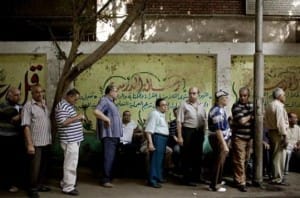
Over the weekend, Egyptians took to the polls to determine their new leader in their first free presidential election since the overthrow of Hosni Mubarak. Ahmad Shafiq, former prime minister of the Mubarak regime, and Mohammed Morsi, conservative Islamist of the Muslim Brotherhood, were running against each other in the first presidential election since Mubarak's overthrow in early 2011. Morsi is believed to be the victor, but uncertainty remains regarding how much power he will have as president. The true result of the election may not be declared until Thursday, according to an electoral supervisor.

The Supreme Council of the Armed Forces (SCAF)  has been the ruling power of Egypt ever since Mubarak stepped down. The SCAF has issued an interim constitution that defines the authority of the new president. The power of the president has been stripped considerably and the most authority is given to the SCAF. The military council has also dissolved the Islamist-led parliament. It appears at this point that no matter who is elected in Egypt, the military will be the true ruling authority.

Egypt is not stable. An economic crisis, not unlike what is occurring in the US and Europe, has led to high unemployment and few prospects for young Egyptians. It is also one of the main reasons why Egyptians decided to protest Mubarak's regime. The political fragility of Egypt has sent many investors scurrying because of fears regarding the military-led government. The conflict between the Muslim Brotherhood and the military-led regime has delayed negotiations regarding a $3.2 billion loan from the International Monetary Fund (IMF). The Wall Street Journal reports that the loan could be a solution to restore investor confidence and help shore up the country's diminishing foreign-currency reserves.

Many Egyptians may not be thrilled with the outcome of the election, regardless of which candidate is finally announced as the new president. The people who took to the streets to protest Mubarak's regime are probably not happy that their only choices for a president were Mubarak's former prime minister or a member of the Muslim Brotherhood. Many Egyptians most likely do not want a new Mubarak-like administration with Shafiq or a Morsi-led Islamic state. It appears that the people who devoted their time to ousting Mubarak are not getting what they want or need. What is worse is that the military seems to have grabbed control of the country and they are not willing to let go of that power, regardless of who is elected. This is clearly not the democratic Egypt that the founders of the April 6th Youth Movement fought for.

Tags: News

Adhere to the IVN etiquette

By posting a comment, you agree to adhere to our etiquette rules: No partisan attacks, no personal attacks, substantiate your sources, no self-promotion.

Get IVN’s Free Weekly Newsletter:Get IVN’s Free Newsletter

Get IVN’s Free Weekly Newsletter:Get IVN’s Free Newsletter

Nonpartisan Issues. Diverse Perspectives.

Check your inbox and click the link to confirm.

Republish this article

Republishing guidelines

Republish IVN articles for free. Independent Voter News articles may be republished online or in print under a Creative Commons BY-NC-ND 4.0 license, on these terms:

  1. Credit the author and IVN. Keep the byline ("By Author Name, Independent Voter News") and the attribution note at the end, which links to the original.
  2. Keep the meaning. You may update time and place references and apply your house style. You may trim for length, as long as the cuts don't change the meaning or misrepresent the author. Keep the headline. Mark any additions as your own (for example "Additional reporting by ...").
  3. Translations are welcome. Translate faithfully, add "Translated from English by [your outlet]", and tell us at editor@ivn.us.
  4. Keep the links, including the link to the original article.
  5. Keep the tracking image. The HTML includes a 1-pixel image that counts readers on your page. It collects no personal information.
  6. Photos and illustrations. Images credited to IVN may be used with this article only. Images credited to others (AP, Getty, Unsplash, Wikimedia and so on) stay under their owners' terms. Secure the rights or switch "Include images" off.
  7. Don't sell it. You can't sell our articles or sell ads specifically against them. Your normal site advertising is fine.
  8. No implied endorsement. Don't suggest that IVN or the author endorses you, your candidates or your causes, or that donations to you support IVN.
  9. Keep labels. Opinion or analysis pieces keep that label.
  10. Point search engines to the original. Set the canonical URL of your copy to the original IVN article (the HTML we give you includes the tag).
  11. No bulk or automated republishing, and don't submit our articles to aggregators (Apple News, Google News, MSN) as your own.
  12. Corrections and removals. Update your copy when we correct it, and remove it promptly if we ask. We'll contact you at the email you give us.
  13. Questions or print republication: editor@ivn.us.

IVN staff: fill in who you're inviting above, then create the invite.

Preparing the article

Uncertainty Remains Over Leadership in Egypt After Election

Choose a format
  • HTML
  • Email HTML
  • Markdown
  • Formatted (.docx)
  • Plain text
  • WordPress blocks
  • PDF
Choose a platform

Photos credited to others need their owners' permission.

To for

Republishing somewhere else? Questions? editor@ivn.us