Skip to content
Sign up free
News

US Policy on Iran Is at a Crossroads for Future President

US Policy on Iran Is at a Crossroads for Future President

By Daniel Block

2-minute read

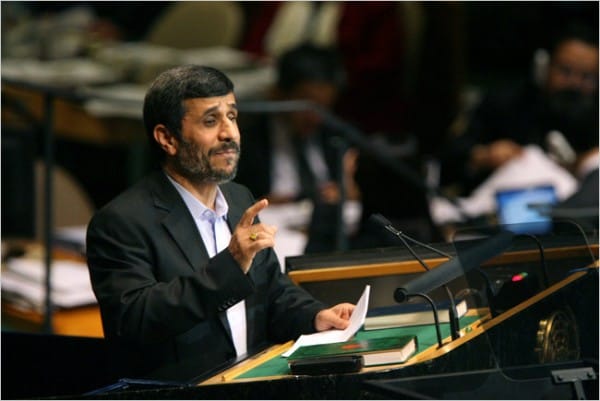
Photo: eutimes.net

As Iran hosts the Nonaligned Movement Conference this week, the Middle Eastern country has shown the international community that it will not bow easily to antagonistic pressure as it gathers countries from all over the world to its capital.

With such an unstable, vocal, and armed government, US policy on Iran often falls into the foreign policy dialogue of both President Obama and presidential hopeful Mitt Romney on the campaign trail.

Presently, US policy on Iran walks a careful line between deterring nuclear breakout capability while not turning the new bubble of free-thinking youth in the Islamic Republic further against the West. This is not easy, as the leadership of Iran has continually pushed on through sanctions, IAEA inspections, and international condemnation.

While both candidates are hesitant to make any commitment to a violent halting of Iranian nuclear capabilities, it is clear that an armed conflict is a viable option alongside tougher sanctions.

It is easy to believe that an actual military strike would be the strongest option to deter Iran, however, an attack will further isolate an already solitary country, and push the younger population behind hard line principles.

In the current regime of Iran, the Supreme Leader has ultimate power over policy. However, to control the actions of all factions and power centers requires a large amount of power and credibility that Iran's government does not possess. Its economy is in shambles and its conventional military is asymmetrical.

The Revolutionary Guards are the main force for keeping order and power in the hands of the Supreme Leader. They are effective at keeping the Ayatollah in power, but this does not help stop public support for other dissenting factions that are more moderate and US friendly. A direct attack on Iran would surely change all of this. The Western boogeyman that so many hardliners point to would become manifest to the Iranian population.

Iran's reasons for wanting nuclear breakout capacity are the same on both popular and leadership levels, namely to be protected in a volatile and isolating region. The difference is that at the popular level, which is filled with a generation that does not remember the Iran-Iraq war, younger Iranians do not feel the imminence of an attack on their soil. A US attack would quickly and irreversibly alter this dynamic, and give the younger generation a tangible enemy to fear and remember, not just a rhetorical talking point.

With this unification of popular opinion, hardliners, and the Ayatollah, policy could change much faster and more dramatically without alienating various disparate factions that were formerly not marching in lockstep with Iran's central government. This would mean an Iran more willing to act outside its borders and pursue a foreign policy of conflict and aggression.

Tags: News

Adhere to the IVN etiquette

By posting a comment, you agree to adhere to our etiquette rules: No partisan attacks, no personal attacks, substantiate your sources, no self-promotion.

Get IVN’s Free Weekly Newsletter:Get IVN’s Free Newsletter

Get IVN’s Free Weekly Newsletter:Get IVN’s Free Newsletter

Nonpartisan Issues. Diverse Perspectives.

Check your inbox and click the link to confirm.

Republish this article

Republishing guidelines

Republish IVN articles for free. Independent Voter News articles may be republished online or in print under a Creative Commons BY-NC-ND 4.0 license, on these terms:

  1. Credit the author and IVN. Keep the byline ("By Author Name, Independent Voter News") and the attribution note at the end, which links to the original.
  2. Keep the meaning. You may update time and place references and apply your house style. You may trim for length, as long as the cuts don't change the meaning or misrepresent the author. Keep the headline. Mark any additions as your own (for example "Additional reporting by ...").
  3. Translations are welcome. Translate faithfully, add "Translated from English by [your outlet]", and tell us at editor@ivn.us.
  4. Keep the links, including the link to the original article.
  5. Keep the tracking image. The HTML includes a 1-pixel image that counts readers on your page. It collects no personal information.
  6. Photos and illustrations. Images credited to IVN may be used with this article only. Images credited to others (AP, Getty, Unsplash, Wikimedia and so on) stay under their owners' terms. Secure the rights or switch "Include images" off.
  7. Don't sell it. You can't sell our articles or sell ads specifically against them. Your normal site advertising is fine.
  8. No implied endorsement. Don't suggest that IVN or the author endorses you, your candidates or your causes, or that donations to you support IVN.
  9. Keep labels. Opinion or analysis pieces keep that label.
  10. Point search engines to the original. Set the canonical URL of your copy to the original IVN article (the HTML we give you includes the tag).
  11. No bulk or automated republishing, and don't submit our articles to aggregators (Apple News, Google News, MSN) as your own.
  12. Corrections and removals. Update your copy when we correct it, and remove it promptly if we ask. We'll contact you at the email you give us.
  13. Questions or print republication: editor@ivn.us.

IVN staff: fill in who you're inviting above, then create the invite.

Preparing the article

US Policy on Iran Is at a Crossroads for Future President

Choose a format
  • HTML
  • Email HTML
  • Markdown
  • Formatted (.docx)
  • Plain text
  • WordPress blocks
  • PDF
Choose a platform

Photos credited to others need their owners' permission.

To for

Republishing somewhere else? Questions? editor@ivn.us