
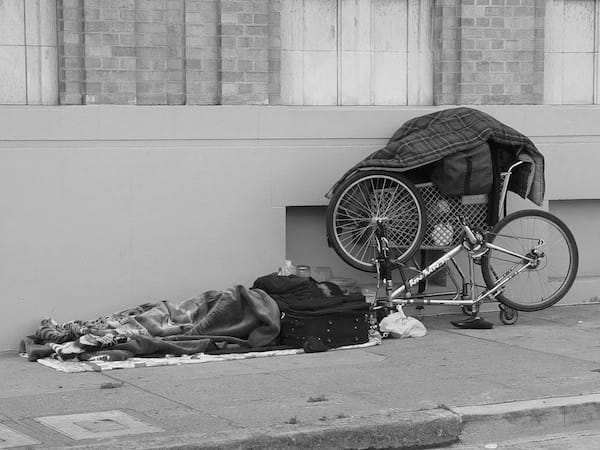
On any given night, an estimated 640,000 Americans lack adequate shelter. That number includes the familiar “chronically homeless.” It includes 67,000 veterans. It includes growing numbers of seniors, the disabled, and families. Over the course of a year, some 3.5 million people, more than a million of them children, will experience homelessness in America. While the tragedy of homelessness and the poverty that causes it are crises enough for the individual, the cost of the big picture is critical for all Americans. Solutions to the issue are both possible and affordable and shouldn't be a partisan issue. Independent voters can lead the way to solving homelessness.
For most people who experience homelessness, the circumstance is short-lived, one they can overcome through utilizing emergency shelter and support networks. But for an estimated 20 percent of people on the streets, traditional shelters, support service systems and intervention have failed to make a lasting impact. As a result, the haunting presence of desperate men and women on the streets of all major cities remains a reminder that there is much work left to do.
The federal government defines a chronically homeless person as a single adult with a disabling condition sleeping in a place not meant for human habitation, and who has been continually homeless for a year or more or has experienced at least four episodes of homelessness in a three-year period. As a group, the chronically homeless typify the image many Americans have of the most down-and-out individuals on the margins of society.
The most common disabling conditions among them are chemical dependency and mental illness, often co-occurring, which result in frequent interactions with law enforcement, visits to emergency rooms, psychiatric units and short-term treatment programs, all of which come at a high cost.
Experts on both sides of the broad political divide see the illogic in allowing chronic homelessness to fester in America. As the Director of the U.S. Interagency Council on Homelessness under the Bush administration from 2002 to 2009, Philip Mangano maintained that one chronically homeless man or woman costs tax payers at least $35,000 a year due to frequent emergency room visits, psychiatric, and other hospital admissions, addiction treatment services, police, court and jail costs. President Obama’s 2009 American Recovery and Reinvestment Act includes $1.5 billion in funding for Homeless Prevention and Rapid Re-Housing.
Yet, both major party presidential candidates have been relatively silent on the issue of solving homelessness, and the word "homeless" is conspicuously absent from their campaign websites.
In its 2009 study Where We Sleep: The Costs of Housing and Homelessness in Los Angeles, The Economic Roundtable in Los Angeles found that for more than 10,000 homeless people they tracked for the study, the average public cost for services was $2,897 a month. This is compared to just $605 for residents in supportive housing.
The nearly five-to-one disparity between the cost of homelessness and the cost of supportive housing identified in the Los Angeles study has been replicated in other cities where programs have been implemented to provide permanent, affordable housing with support services for homeless individuals and families.
It’s an easy difference to account for given the results of a 2004 study by the Lewin Group, which found that in nine major cities the average cost of a night in jail was $81, with psychiatric facilities costing $550 and hospitals a staggering $1,638. At $27 per night, even the average cost of a basic emergency shelter with no long-term services exceeded the cost of permanent, service-enriched housing.
Applying the Los Angeles figures to all homeless Americans, in a single night 640,000 people sleeping on the streets represent a cost of more than $61 million in publicly funded services, while supporting that same population in permanent housing would cost less than $13 million, a savings of $48 million per night or $17.5 billion a year.
Homelessness is, to some extent, an intrinsically moral issue, evidence of something gone badly awry in terms of priorities, distribution, access and opportunity. Providing for the most basic needs of millions of men, women and children is an exigency of sheer human decency and should need no monetary justification. Homelessness is also a practical problem to be managed, hopefully to be minimized, and in the best case to be remedied through adjustments to policy and practice.
Robert Coleman is the Executive Director of San Diego’s Second Chance Program, an organization that provides housing, counseling, case management and job readiness training to over 1,500 men, women, and youth each year. Second Chance serves those seeking independence through employment and, according to Coleman, “What might be a day’s pay for a typical executive is a month’s survival for someone looking for work.” He maintains that Second Chance can provide sober housing, food, transportation and mental health services for one month at a cost of $599 per person for participants in an intensive, four-week job readiness training program.
For Coleman, the economic argument in favor of solving homelessness is just one part of the equation. “Just this morning,” he said, “I spoke with a client who came here to get a job. He did get a job and as a result he is now reunited with his three children. The ultimate outcome is something you can’t really put a price tag on. What is it worth to bring families together? How do you measure that? For me, whatever it cost it was worth it. But for those who aren’t moved sufficiently by the human element, yes, it’s also better for all of us, economically, that a man is now employed, paying taxes, and raising his children in a loving home.”
Solving homelessness is both possible and affordable. It should not be a partisan issue. It should instead be an issue with broad appeal to any policy-maker or voter. If the major parties won’t address it, then perhaps only informed, independent voters will drive the dialogue that can lead to lasting outcomes.
A real, comprehensive plan to solve homelessness once and for all appeals to both the heart and the wallet. It is well past time for the right elected leader to address the facts about a problem that costs all Americans every day and to put forward a plan for a large-scale response that will save money and remake our cities, reflecting what is best in this country’s spirit and its common sense.
*The STRIVE Job Readiness Training Program offered by Second Chance is currently featured in an eight-part documentary series airing on Mondays at 10:00 p.m. on the Sundance Channel. To view Episode 1 in its entirety, visit http://www.sundancechannel.com/get-to-work/.