
Credit: bpdvt.org
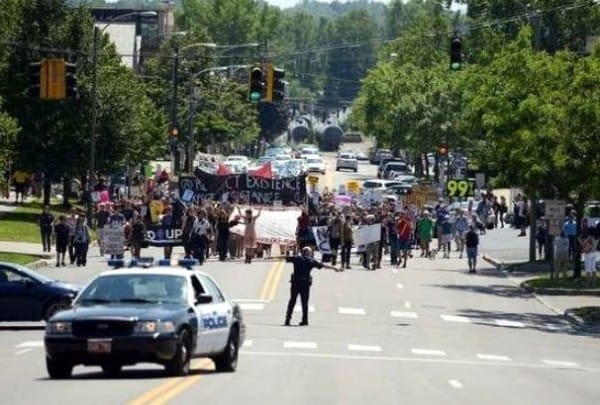
Apparent police violence at a protest at the New England Governor’s and Eastern Canadian Premier’s Conference on July 29 in Burlington, VT provoked weeks of complaint. An 83-page “Preliminary After Action Report” from police argues the officers involved “showed exceptional professionalism under adverse, complex, and rapidly evolving circumstances.”
The Burlington Police Dept. released the report late on Friday, August 24, resulting in scant initial news coverage. Despite its positive self-assessment, the report has not allayed concern over police behavior, with four of Burlington’s city councilors already calling for an independent investigation of the July 29 action.
The report focuses on the two brief confrontations between police and demonstrators late in a day characterized by peaceful demonstrations and police cooperation, albeit limited effective communication between the two groups.
The report makes clear that the Burlington mayor’s office, the Burlington police, the Vermont State Police, and other security agencies were well aware of the planned demonstrations, which were widely publicized locally and on the internet for weeks in advance. The report notes that the day before the demonstrations, police Lt. Arthur Cyr sought to meet with some of the many organizers of the protest only to be “rebuffed.” The report omits the previous visit of FBI agents to other organizers, a visit taken as an act of intimidation that reinforced distrust of police among Occupy activists and others.
Not surprisingly, police planners brought their own deep-seated distrust to the occasion, as the report makes clear. The items the police identified as somehow threatening included red squares on people’s clothing, black flags, goggles, face masks, and milk. The report gives no indication of understanding that the red squares indicate solidarity with student activists in Quebec or that the black flag is a traditional banner of anarchism. Nor does the report offer any comprehension that goggles, masks, and milk are some of the usual defensive paraphernalia carried by people who expect that they might be tear-gassed.
As it turned out the milk was useful in treating the demonstrator who was pepper-sprayed in the face at close range.
The action that precipitated the police violence was a human blockade of the hotel driveway exit, preventing buses filled with of dignitaries from going to dinner without running over people. Perhaps two dozen people stood in the way of the buses and wouldn't move when Lt. Cyr asked them to. The report is unclear as to what orders or threats of arrest were made, there is no transcript, and video of the even suggests the mood was much more relaxed than one expects during a “confrontation.” Body language of the demonstrators and police is strikingly relaxed, people milling about, hands at their sides.
The report makes clear that the demonstrators had peacefully backed off from their initial position down the driveway, when asked by police to move back. There had been no physical contact during that movement.
That relaxed mood changed when Lt. Cyr brought in a security detail of helmeted officers with shields and batons to confront the blockading demonstrators. The demonstrators remained in place as the riot police marched forward and initiated physical contact, quickly clearing a path that allowed a bus to leave.
The report makes clear that the police initiated physical contact, including Lt Cyr “putting his hand on the arms of demonstrators.” The report also notes that most demonstrators dispersed without resistance. The report asserts that some demonstrators resisted, but the visual evidence fails to show that clearly. The report fails to address the question of how to allow people in a crowd to withdraw peacefully when they’re being pushed or, as one picture seems to show, choked by Lt. Cyr.
According to the report, Lt. Cyr lunged into the crowd and then felt threatened because he was surrounded. There is no allegation that anyone hit him, threw anything at him, or was otherwise aggressive. There are pictures of Lt. Cyr grappling with people lying on the ground, even though they were no longer in the way of the bus.
While the report makes assertions of demonstrators pushing back against the riot police, the pictures offered rebut that assertion. Only one picture shows a demonstrator whose legs are braced as if he’s pushing on something. The rest show people standing around or being pushed.
Only after the police clear the demonstrator blockade and let the first bus pass do they escalate their violence to using pepper pellets and pepper spray, while charging and chasing demonstrators.
Perhaps the most glaring contrast between what the report says and what the report’s pictures show emerges from the sequence involving Marni Salerno. Police say she grabbed an officer’s baton, and one picture of Salerno standing relaxed but face-to-face with an officer is possibly consistent with her having a hand on his baton at waist level. Her other hand is hidden.
But images from the officers body-mounted videocam seem to tell a different story. We see the officer closing in on a buxom young woman and forcing his baton against her rib cage, just below her breasts. Only then, as the pictures show, did she possibly push his baton away and down. For that, an officer a few feet away shot her twice, in the side and in the elbow, with pepper balls.
For all that the report seeks to justify almost everything the police did, what it achieves is a quite different effect. It shows leadership at least as high as the mayor’s office with no apparent understanding about what the demonstrators are doing or why they’re doing it, and having no plan for responding to even the most elementary, predictable tactics of peaceful resistance.
The report offers this conclusion: “Officers showed exceptional professionalism under adverse, complex, and rapidly evolving circumstances.” But the evidence it offers shows a lack of professionalism in police acting violently once the blockade is removed. The event was hardly complex: there was a hastily established human blockade, it was easily removed. About the only thing that evolved rapidly was the sudden, brief burst of police violence.
The report blames this on a handful of demonstrators. But the report omits the police officer who charged into the blockade at the same moment the riot police started pushing. This video looks like the precipitating event, since the charging officer would have been pushing against people in the blockade, forcing them towards the riot police shields. This officer is not identified and his actions are not discussed.
The full report is available both on line and in printed copy for $30.60 from the Burlington Police Dept.