
Credit: defense.gov
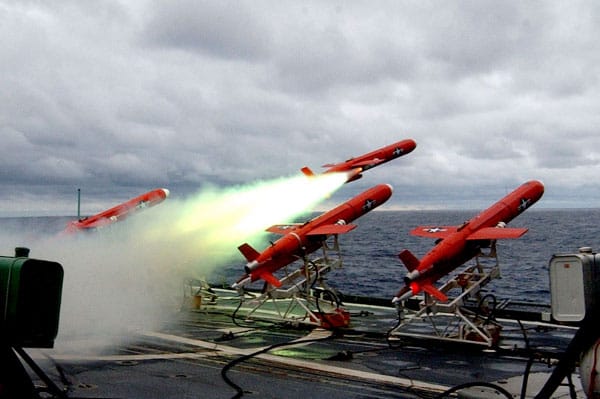
In an article titled, "US drone strikes target rescuers in Pakistan," Glenn Greenwald reports that the US government is using tactics on the battlefield that it has criticized in the past as characteristic of terrorism.
Yet drone strikes may never be a political issue in the US because of a broad bipartisan consensus in support of them. Should drones be used to kill, and if so, when?
A familiar terror tactic, which the US Department of Homeland Security calls “double tap,” is a favorite technique of Hamas. The notion is simple: set off a bomb to kill and injure people, drawing in rescuers, reporters, and relatives-- then set off a second, larger bomb that does even more damage, and inspires more terror.
The government in Washington employed the same technique in an aerial drone strike this Sunday, in the North Waziristan Agency of Pakistan. The International Herald Tribune identified the dead as “militants,” even though there is no way of knowing this for sure because of the Obama Administration's dubious definition of "militants" as any "military-age male in a strike zone."
The Sunday drone strike was part of the ongoing “targeted killing” program that Washington has operated for years-- and significantly expanded during the Obama Administration. Under this program, in which the official kill list is personally approved by the president himself, the government has whitewashed civilian death counts with a post hoc definition of "militant" that functionally says if a person is not a woman or child, and Washington kills him with a drone strike, then he was an enemy combatant.
Given the administration’s Orwellian definition of “militants” and the difficulty of independently identifying the dead, it’s unsurprising that civilian deaths in Pakistan and other drone-combat zones are much more common than has been reported.
Objections to Washington's drone program come largely from outside the United States, and are most prevalent in the target countries such as Pakistan, Afghanistan, Yemen, and Somalia, although opposition to Washington drone strikes is also widespread in countries like Germany, Japan, France, Poland, Italy, Mexico, Spain, China, Russia, Brazil, and Greece.
More common in the United States is the opinion of Bradley Strawser, a tenure-track assistant professor at the US Naval Postgraduate School in Monterrey, California, where Navy officers earn master’s degrees and doctorates.
Something of an official government philosopher, Strawser sees nothing morally wrong with drone strikes, but rather argues in the journal of Military Ethics that Washington has a moral obligation to use drone strikes because its cause is just.
Official objection to Washington's drone program has been limited. In May, Reps. Dennis Kucinich and John Conyers introduced an amendment to the defense appropriations bill to limit drone strikes, but it was rejected. Kucinich also circulated a letter in Congress seeking accountability and transparency for the drone assassination program. Nine other representatives signed the letter.
In June, Kucinich warned that Pakistan’s objections to American drone strikes put the two countries close to a state of war. Kucinich said, “When you have assassination programmes that lack any attempt to establish legal justification, then you have journeyed into moral depravity. International law means nothing, laws of war mean nothing.”
That same week in June, former president Jimmy Carter published an op-ed piece in the New York Times attacking President Obama’s drone policy, saying, “We don’t know how many hundreds of innocent civilians have been killed in these attacks, each one approved by the highest authorities in Washington. This would have been unthinkable in previous times.”
In 2011, after a drone strike killed an American citizen in Yemen, Congressman Ron Paul suggested this was possibly an impeachable offense by the Nobel Peace Prize-winning president, but the suggestion never gained traction.
The same survey that found extensive opposition to Washington drone strikes in other countries, found one country firmly in favor of the tactic: the United States, with 62 percent of the population supporting its government's drone operations overseas. Among Republicans, support was highest, at 74 percent. Independents were 60 percent in favor, closely followed by Democrats at 58 percent.