

The Indian economy has been sluggish as of late. Corresponding to an underwhelming growth rate, the rupee has also lost substantial strength in the global market. In fact, the rupee has fallen to over 60 to the U.S. dollar - the lowest it has ever been.
A few factors contribute to this weakening. First and most obvious, the weak Indian economy and unstable political atmosphere created uneasiness in the currency markets, essentially devaluing the currency. A stronger and more stable economy raises investors' demand of that currency.
Following this, tensions over Syria generated uncertainty in the currency markets, which, along with rising trade deficits, also weakened the rupee.
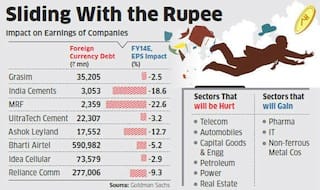
This situation adversely affects the citizens of India and certain sectors of the economy. Most importantly, imports become more expensive since it now takes more rupees to buy the same goods.
As imports become more expensive, companies and businesses often impose higher prices on consumers to account for lost revenue. This can greatly impact prices on goods and services, especially when the price of oil increases.
Transportation costs, for example, will increase. This means that traveling and commuting will cost the consumer more money, diverting spending from other sectors of the already weakening economy.
This can curtail into more job loss if spending decreases enough as a result of this. Supplementing this possibility concerns the weariness of foreign investment in an unstable economy. With less investment, Indian citizens will see less job opportunities, making it even harder for the unemployed to keep up with rising prices.
In order to potentially curtail the rising costs of goods, India has considered increasing oil imports from Iran within the limits of the U.S. and U.N. sanctions. By doing so, India could directly trade with rupees, instead of trading with a different currency. This avoids a harmful exchange rate, thus potentially saving India billions in U.S. dollars.
Despite all this, a depreciating rupee does have a silver lining.
Because one can receive more rupee per domestic currency, Indian goods will become cheaper for other countries. In other words, Indian exports will increase.
As a result, some feel that the rupee crisis actually helps the Indian economy.
Prime minister and former economist Manmohan Singh feels that "to some extent, depreciation can be good for the economy."
The data supports his premise. In the past few years, the U.S. trade deficit with India has greatly increased relative to the years prior. In 2013 (up to and including July), the deficit has reached about $12.2 million. In 2010, the deficit for the entire year reached about $10.3 million.
In addition, India's trade deficit shrunk to $10.9 billion in accordance with the rise in exports. Companies that rely on exports (e.g. clothing) should see a boost in revenue. This in turn may increase the number of jobs if the businesses need to expand in order to keep up with rising demand.
As for the global economy, countries may want to take advantage of cheaper goods despite increasing their deficits. Investors may think twice about selecting India. And India's trade balance will surely affect the way it conducts business with other countries. It remains unknown how long this depreciated currency will last; however, the longer it lingers, India will have a harder time fixing its economy and unstable political atmosphere.