
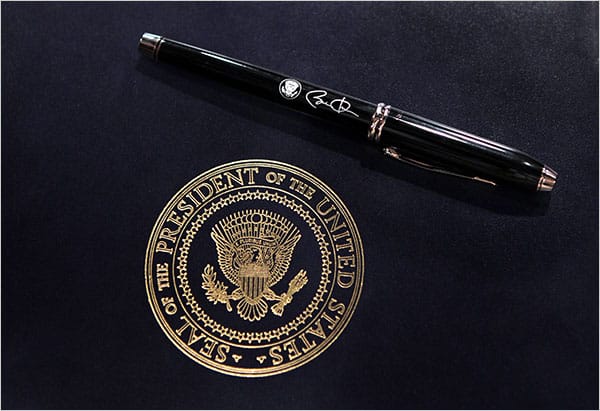
On Wednesday, President Obama signed 23 executive orders that will address the issue of gun control in the United States in various ways, including measures to improve the federal background check system, promote programs that educate the public on gun safety and responsible gun ownership, and provide incentives for schools to hire on-campus resource officers.
These action have been seen by a fringe group of the electorate as an unconstitutional abuse of power by the president. However, when examining the origin and history of the executive order, it seems that history ultimately decides whether or not an executive order is an abuse of power.
Where does the power of the executive order come from?
There is nothing in the U.S. Constitution that directly speaks of executive orders. Executive power, however, is laid out in Article II and details the responsibilities of the President of the United States. Specifically, when executive orders are looked at, the focus turns to Article II, section 3:
“The President shall take care that the laws be faithfully executed.”
An executive order is a proclamation by the president to direct federal agencies and officers on enforcing laws that already exist or to exercise additional authorities given to the president by the constitution.
However, the extent of the president's power to use these executive orders is a grey area which has left the issue to heavy debate over the last 200 years. Justice Rober H. Jackson observed:
A judge
The use of executive power has been further determined by its wise use by great presidents such as Georges Washington, Abraham Lincoln or Franklin D. Roosevelt which, by their invaluable legacy on American politics, have legitimized the executive order's use -- although, not without critics.
Controversial Use of Executive Orders
The purchase of Louisiana by Thomas Jefferson from Napoleon was made by an executive order under the doubtful theory that this power was indirectly vested in the presidency to produce treaties. Recent reviews have considered this act as an unconstitutional use.
In 1861, Abraham Lincoln suspended the right of habeas corpus and seized the railroads and telegraph system for military use. Some scholars call this the era of "constitutional dictatorship," during which the government was running with clear opposition from Congress.
During Word War II, FDR used many executive orders, and among these was the decision to create the Japanese internment camps.
If the first two controversial examples described above have gone down the path of history as being the right decision, FDR's decision on the internment camps has emerged in retrospect has a horrendous error.
Limited Intervention of the Congress or Courts
It is neither the Congress nor the courts, but rather history and retrospection, that has decided if the president's use of executive power was a gross misuse. Legal scholar Kenneth R. Mayer, in the book Constitutional Presidency, has noticed that if the courts and Congress have the power to overturn the president's action by enacting a law or by ruling that an executive order is illegal, they rarely chose to do so.
Between 1970 and 1998, the Congress explicitly overturned an executive order by enacting a statute on only 3 occasions. Over the same period, presidents issued over a thousand executive orders.
As for the courts, they have often stayed out of the president's way. Between 1943 and 1997, and over 4,000 executive orders, only 14 were ruled invalid, including the famous attempt by President Truman to seize the steel industry during the Korean War.
Ironically, a more efficient check over the executive power is the orders presented by the next president, especially if he or she is from another party. A famous example is an executive order by George H.W. Bush requiring federal contractors to inform their employees that they are not required to join a union. This executive order was revoked by Bill Clinton and then reinstated by George W. Bush and reversed again by Obama.
What Now?
Executive orders have been used by presidents as a governing and policy tool since the beginning of the Republic, and by every president since. Some have made a greater use of these orders, often in occasion justified by extreme circumstances such as the Civil War or the World Wars.
As author and scholar David Abshire said in an interview, "the Greater the crisis, the greater the increase of power. And the greater the power is, the greater the abuse can be."
Obama's use of executive orders to address the issue of gun violence in the U.S. will be criticized by the Congress and Americans, but contention within politics is nothing new. Some of the executive orders might be overturned by the Congress, invalidated by a court or revoked by the next president. The only certainty is that it will be history which clearly decides if this was an appropriate use of presidential powers.